Mathematics · Updated June 2026
How to Learn Linear Algebra and Solve Systems of Equations with AI Safely
Master augmented matrix setups, row operation rules, Gaussian elimination, back-substitution, and matrix ranks using Socratic AI coaching safely.
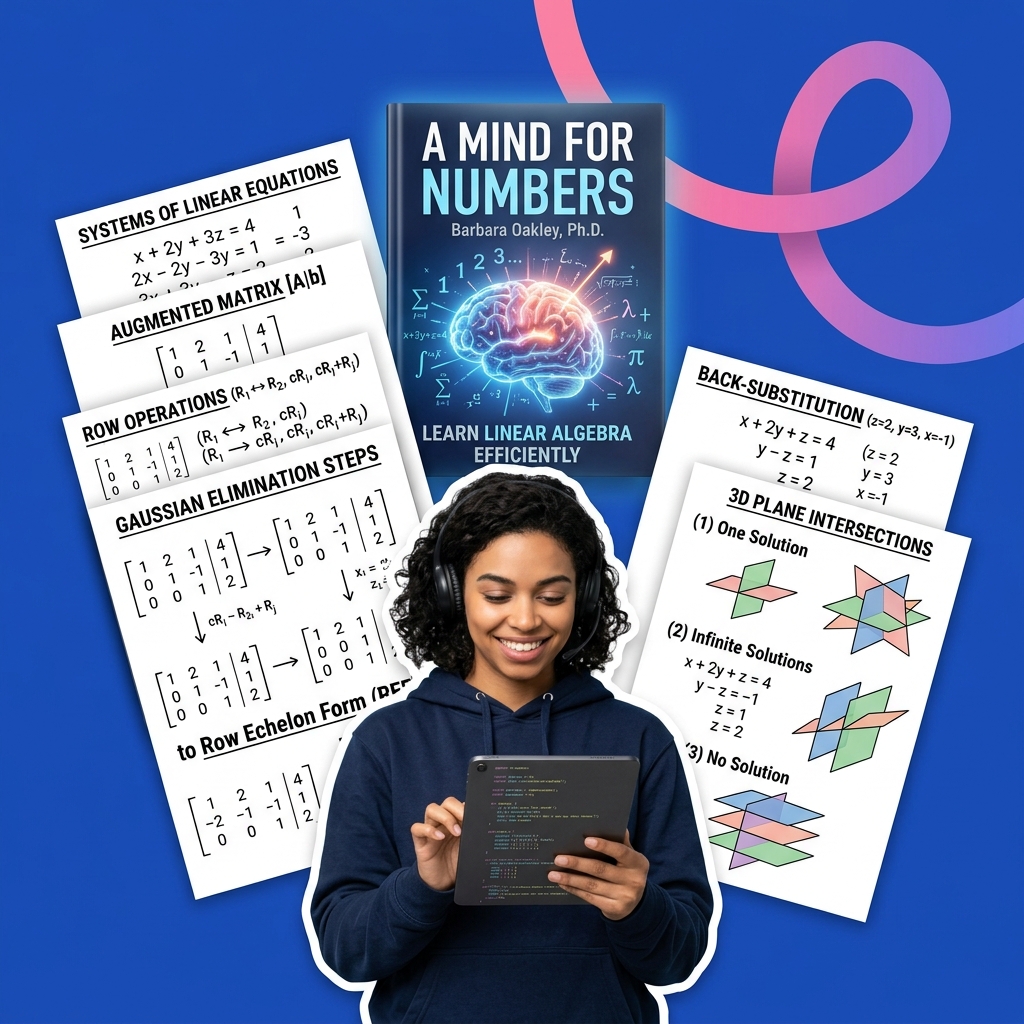
In linear algebra and applied mathematics, solving systems of linear equations is the fundamental problem that underlies everything from computer graphics and structural engineering to machine learning and economic modeling. A system of linear equations can be represented compactly as a matrix equation, $Ax = b$, and solved systematically using Gaussian elimination (also known as row reduction).
Gaussian elimination transforms an augmented matrix—which combines the coefficient matrix $A$ and the constant vector $b$—into Row Echelon Form (REF) using three elementary row operations:
- Swapping two rows.
- Multiplying a row by a non-zero constant.
- Adding or subtracting a multiple of one row to another row.
Once the matrix is in Row Echelon Form, you solve for the variables from bottom to top using back-substitution. If you continue the row reduction until the leading coefficient of each row is 1 and all other entries in its column are 0, the matrix reaches Reduced Row Echelon Form (RREF) (often called Gauss-Jordan elimination).
Because performing arithmetic operations on matrices is highly repetitive and prone to simple calculation errors, students frequently ask AI models to reduce matrices or solve systems of equations for them. However, letting AI do the arithmetic prevents you from learning how to identify pivots, spot row dependencies, and determine the rank of a matrix—skills that are essential for understanding vector spaces, null spaces, and linear independence. This guide outlines a Socratic workflow to utilize AI as a linear algebra coach.
Step 1: Setting Up the Augmented Matrix Socraticly
Before you can apply Gaussian elimination, you must translate the system of linear equations into an augmented matrix. This step is critical because failing to align variables or missing zero coefficients will ruin the entire calculation.
Using AI to construct the matrix directly deprives you of learning how to map algebraic variables to multi-dimensional arrays.
Use this Socratic prompt to check your matrix setup logic:
I am representing a system of three linear equations with variables x, y, and z as an augmented matrix. The second equation is 3x - 5z = 8 (there is no y term). Act as a Socratic linear algebra tutor. Do not write the matrix for me. Ask me to explain how to represent missing variables in a coefficient array. Prompt me to write out the second row of the augmented matrix. Guide me.Step 2: Formulating Row Operations and Pivot Strategy Socraticly
The goal of Gaussian elimination is to create a triangular structure where the first non-zero entry in each row (the pivot) is to the right of the pivot in the row above it. Choosing the right pivot and planning row operations carefully minimizes fractional arithmetic and prevents calculation errors.
Letting AI choose and perform the row reductions directly prevents you from developing the tactical sorting patterns needed for manual matrix math.
Use this prompt to master pivot selection Socraticly:
I have an augmented matrix where Row 1 is [2, 4, -2 | 8] and Row 2 is [1, -3, 5 | -2]. Act as a Socratic linear algebra coach. Do not perform any row reductions for me. Ask me to compare the current pivots, and prompt me to decide whether swapping the rows or scaling Row 1 is a more efficient first step to avoid working with fractions. Guide me.Step 3: Auditing Matrix Rank and Solution Types Socraticly
A system of linear equations can have three possible outcomes: a unique solution (intersecting lines/planes), infinitely many solutions (dependent systems with free variables), or no solution (parallel lines/planes). You identify these states by analyzing the rank of the matrix and looking for inconsistent rows (like $[0, 0, 0 | 5]$).
Use this Socratic prompt to check your matrix solution analysis:
I have reduced an augmented matrix for a 3-variable system, and the bottom row is [0, 0, 0 | 0], while the middle row is [0, 1, -2 | 3]. Act as a Socratic linear algebra tutor. Do not solve the system. Ask me to explain what a row of all zeros represents in terms of variable constraints. Prompt me to define "free variables" and determine the total number of solutions. Guide me.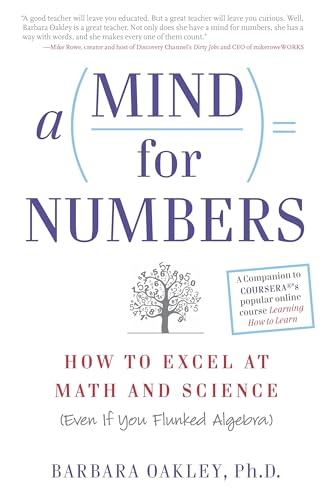
A Mind for Numbers: How to Excel at Math and Science
Dr. Barbara Oakley's actionable guide to unlocking analytical thinking. Perfect for students tackling STEM classes who want to beat procrastination and master complex formulas.
AI Study Pilot receives a small commission from qualifying Amazon purchases at no extra cost to you.Common mistakes
Be on the lookout for these classic pitfalls when solving systems of equations:
- Violating Elementary Row Operation Rules: A common student error is multiplying two rows together or dividing a row by zero. Elementary row operations must only scale single rows or add scaled rows to other rows. Ask AI: "Quiz me Socraticly on the properties of elementary matrices and why row operations preserve the solution set of the system. Guide me."
- Losing Track of Arithmetic Signs: More than 90% of manual matrix reduction errors are caused by basic sign errors (e.g., adding $-3 \times 2$ to $5$ and getting $11$ instead of $-1$). Write out each row operation formula explicitly (e.g., $R2 \leftarrow R2 - 3R_1$) before executing it.
- Assuming RREF is Always Required: Many students waste time fully reducing a matrix to Gauss-Jordan form ($RREF$) when simple Gaussian elimination ($REF$) followed by back-substitution would solve the variables much faster. REF is computationally cheaper and highly preferred for manual checks. Ask AI: "Socraticly quiz me on comparing the computational complexity (flop count) of REF with back-substitution versus RREF. Guide me."
FAQ
- What is partial pivoting and why do computer libraries use it? In numerical linear algebra, computer algorithms swap rows to place the largest absolute value in the pivot position. This is called partial pivoting and is crucial for reducing round-off errors and preventing division by numbers close to zero. Prompt: "Act as a Socratic numerical analyst. Quiz me on the relationship between floating-point precision, pivot size, and round-off error. Guide me."
- How does the determinant of the coefficient matrix relate to the solution set? If the coefficient matrix $A$ is square and its determinant is non-zero ($\det(A) \neq 0$), the matrix is invertible, and the system has a unique solution. If $\det(A) = 0$, the system has either zero or infinitely many solutions. Prompt: "Socraticly quiz me on the Invertible Matrix Theorem and how determinants relate to matrix rank and systems of equations. Guide me."
- Can Gaussian elimination be used to find a matrix inverse? Yes. By appending the identity matrix $I$ to the right of a square matrix $A$ to form $[A | I]$ and row-reducing the entire block to $[I | A^{-1}]$, you calculate the inverse. Prompt: "Socraticly guide me to understand why row reducing [A | I] to [I | B] mathematically guarantees that B is the inverse of A. Guide me."
Final recommendation
Solving systems of equations is the gateway to understanding higher-dimensional vector spaces. Do not delegate your matrix reductions or algebraic back-substitutions to AI. Instead, draw your coordinate planes, write out your row operations step-by-step, check your signs manually, and use Socratic AI triggers to audit your pivot choices, linear dependence limits, and matrix rank calculations.
Disclosure: AI Study Pilot may add affiliate links later. We recommend free-first tools where possible and never promise guaranteed grades or outcomes.