STEM study · Updated June 2026
How to Learn Linear Algebra and Visualize Vector Transformations With AI Safely
Learn how to use AI safely to visualize vector spaces, understand linear transformations, and master eigenvalues conceptually.

Linear algebra is the mathematical backbone of modern technology. It powers computer graphics, 3D game engines, neural networks, data science algorithms, and quantum physics simulations. However, for most college students, linear algebra is a jarring shift from the procedural calculations of calculus. Suddenly, you are thrust into an abstract world of vector spaces, spans, linear independence, null spaces, and eigenvalues.
The biggest mistake students make in linear algebra is treating it as a class about memorizing matrix arithmetic (like row reduction or matrix multiplication). Anyone can learn to reduce a matrix; computers do it instantly. Exams test your conceptual understanding of what these matrix operations actually do to space.
AI models are exceptionally good at helping you visualize abstract math, translating algebraic theorems into geometric descriptions, and explaining the physical meaning behind matrix equations. You can use an AI as a personalized mathematics tutor to build intuitive mental models of vector spaces, explain the geometric intuition of transformations, and guide you through complex proofs.
However, using AI to solve your homework matrices or write your mathematical proofs is a violation of academic integrity. The key is to use the AI to build your geometric intuition and verify your logical steps, while performing the algebraic operations and writing the proofs yourself.
Conceptual linear algebra workflow with AI
- Differentiate algebra from geometry: Always ask what an algebraic operation (like finding a determinant) means geometrically (measuring area scaling).
- Visualize transformations as space morphing: Understand matrices as actions that morph, stretch, or rotate vector spaces.
- Deconstruct eigenvalue equations: Focus on how operators interact with specific vectors without changing their direction.
- Practice theorem-proving logic: Discuss the conceptual connections between theorems (such as the Invertible Matrix Theorem) with the AI.
Building Intuitive Chunks for Abstract Math
Abstract math classes like linear algebra can induce cognitive paralysis because n-dimensional vector spaces cannot be visualized physically.
In A Mind for Numbers: How to Excel at Math and Science, Dr. Barbara Oakley details how to master abstract subjects by building "chunks" — strong mental loops that connect new mathematical concepts to familiar physical or visual ideas.
To study linear algebra effectively, focus on building geometric chunks. Before diving into the algebra of a transformation, use an AI assistant to explain what that transformation does to a simple 2D grid. Set up a pomodoro visual study block, sketch the grid before and after the transformation on paper, and write down the matrix's actions in plain English (e.g., "This matrix shears the y-axis by a factor of 2"). This active visualization translates abstract symbols into concrete mental representations, preventing the illusion of competence on exams.
The Vector Space Visualization Prompt
To understand the geometric intuition behind abstract matrix operations and practice setting up problems, use this prompt:
Act as a college mathematics professor. Explain the concept of [insert concept, e.g., the Null Space of a matrix] conceptually.

Please generate a study guide:
1. Explain the algebraic definition in plain language (no abstract symbols yet).
2. Provide a 2D or 3D geometric analogy of what this concept represents visually.
3. Explain why this concept is practically useful in computer science or engineering.
4. Provide a simple 2x2 matrix and ask me 3 guided questions to help me find and describe its null space geometrically.
Step-by-Step Linear Algebra Review
Step 1 — Geometric transformations
If you are learning about matrix multiplication, understand it as composition of linear transformations. Ask the AI:
Explain what it means geometrically to multiply two 2x2 matrices, A and B, in the order AB. How does the order of multiplication affect the final vector transformation?Step 2 — Deconstruct the Invertible Matrix Theorem
This theorem links dozens of concepts (invertibility, linear independence, span, null space, determinant). Ask the AI to test your understanding of these connections:
Act as a math tutor. Select 3 different statements from the Invertible Matrix Theorem (e.g., linearly independent columns, determinant is non-zero, and span is R^n). Explain conceptually why each statement implies the other.Step 3 — Run a proof outline drill
Exams often require you to prove algebraic statements. Use AI to verify your logical steps without writing the proof for you:
I need to prove that if a matrix A is invertible, its transpose is also invertible. Please provide a high-level logical outline of the proof steps. Do not write out the equations. Ask me which theorem or algebraic property I should use at each step.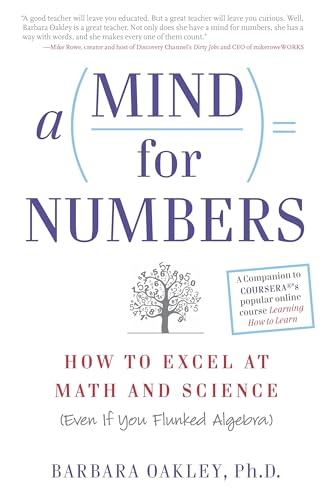
A Mind for Numbers: How to Excel at Math and Science
Dr. Barbara Oakley's actionable guide to unlocking analytical thinking. Perfect for students tackling STEM classes who want to beat procrastination and master complex formulas.
AI Study Pilot receives a small commission from qualifying Amazon purchases at no extra cost to you.Common mistakes
* Row-reducing without checking independence: Never assume a matrix has a unique solution before checking if its determinant is non-zero or if its columns span the space. Use AI to practice identifying singular matrices by inspection.
* Confusing dimensions and coordinate systems: AI can help you understand the difference between the dimension of a vector space and the coordinate system used to represent vectors. Review change-of-basis rules conceptually.
* Letting AI write proofs: Writing mathematical proofs builds logical reasoning. If you let AI write your homework proofs, you will fail to build the procedural memory needed to construct proofs on your midterm.
Disclosure: AI Study Pilot may add affiliate links later. We recommend free-first tools where possible and never promise guaranteed grades or outcomes.