Organic Chemistry · Updated June 2026
Learn Nucleophilic Substitution and Elimination with AI Safely
Master substrate effects, leaving groups, nucleophiles, solvents, and reaction coordinate diagrams using Socratic AI coaching to build organic chemistry intuition safely.
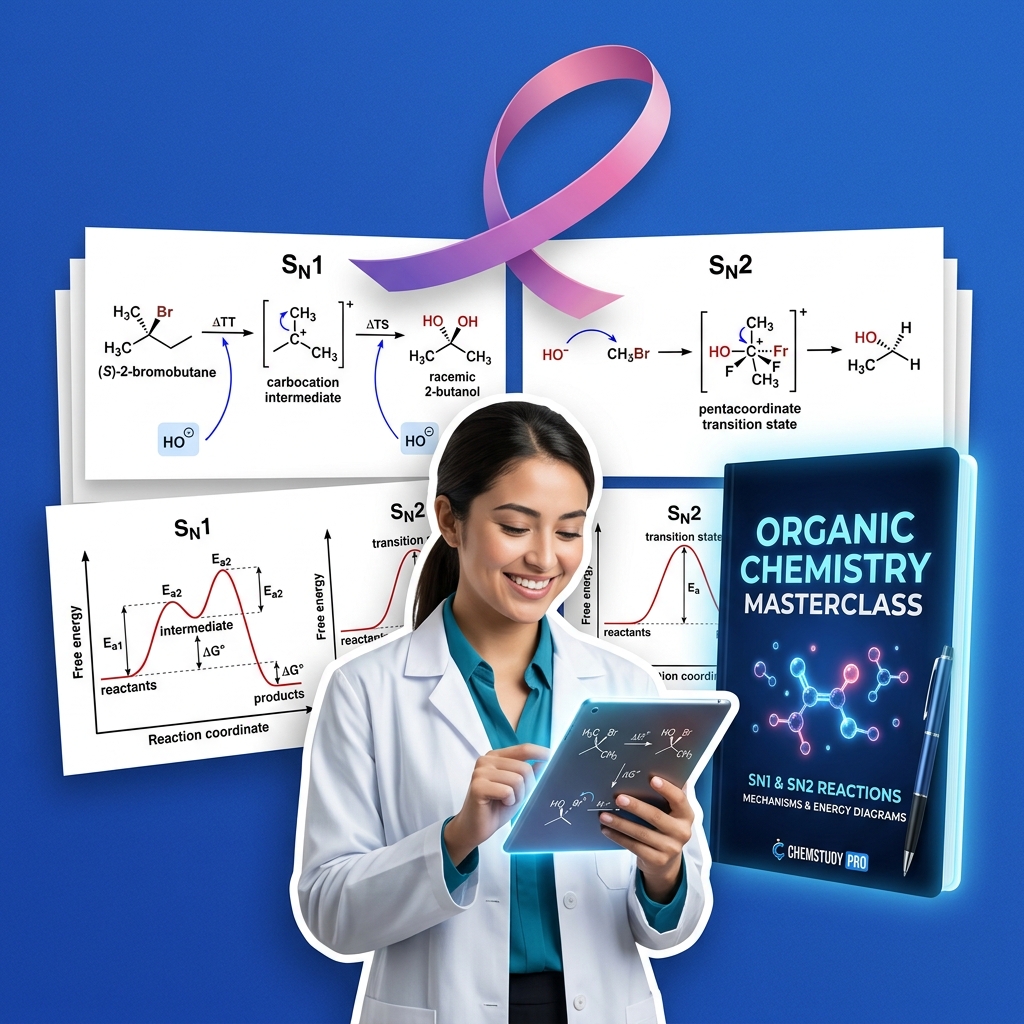
In organic chemistry, aliphatic nucleophilic substitution ($SN1$ and $SN2$) and elimination ($E1$ and $E2$) represent the foundational pathways by which alkyl halides and related compounds undergo reaction. These four pathways are highly competitive, and determining which pathway dominates under a given set of conditions—substrate structure, nucleophile/base strength, solvent type, and temperature—is one of the most critical problem-solving skills in introductory organic chemistry.
Here is a brief overview of the four competing pathways:
- $S_N2$ (Substitution Nucleophilic Bimolecular): A concerted, single-step reaction where the nucleophile attacks the substrate from the backside (opposite the leaving group) at the same time the leaving group departs. This results in the stereochemical inversion of configuration at the stereocenter.
- $S_N1$ (Substitution Nucleophilic Unimolecular): A stepwise reaction where the leaving group departs first to form a planar carbocation intermediate. The nucleophile then attacks from either face, yielding a racemic mixture of enantiomers.
- $E2$ (Elimination Bimolecular): A concerted, single-step reaction where a strong base extracts a beta-proton while the leaving group departs, forming a double bond. This requires an anti-periplanar transition state geometry.
- $E1$ (Elimination Unimolecular): A stepwise reaction that shares its carbocation intermediate with $S_N1$. The base then extracts a beta-proton to form the most stable alkene (Zaitsev's rule).
Because determining the correct mechanism requires integrating multiple variables, students frequently ask AI to predict the products of their reactions or draw the mechanisms directly. However, using AI to draw mechanism arrows or write out final products prevents you from developing the structural intuition needed for synthesis design. This guide outlines a Socratic workflow to utilize AI as an organic mechanisms coach to master substitution and elimination safely.
Step 1: Evaluating Substrate & Leaving Group Effects Socraticly
The structure of the substrate is the primary factor in determining the mechanism.
- Methyl and Primary ($1^\circ$) Substrates: Extremely unhindered, making them ideal for $SN2$ backside attack. They cannot form stable carbocations, making $SN1$ or $E1$ impossible.
- Tertiary ($3^\circ$) Substrates: Highly stericly hindered, preventing $SN2$ backside attack entirely. However, they form highly stable tertiary carbocations, favoring $SN1$ or $E1$ (or $E2$ if a strong base is present).
- Secondary ($2^\circ$) Substrates: The trickiest case, as they can react via any of the four pathways depending on the other reaction parameters.
Additionally, the leaving group must be stable as a weak base (e.g., $I^-$, $Br^-$, $Cl^-$, or $OTs^-$) to facilitate departure.
Use this Socratic prompt to check your substrate and leaving group understanding:
I am learning to analyze alkyl halide substrates for substitution and elimination reactions. Act as a Socratic organic chemistry tutor. Do not predict reaction products or write down mechanisms. Ask me to compare a primary vs. a tertiary alkyl halide substrate, explaining how steric hindrance impacts the SN2 pathway and how carbocation stability influences the SN1 pathway. Guide me.Step 2: Assessing Nucleophile, Base, and Solvent Effects Socraticly
Once the substrate type is identified, the strength of the nucleophile or base determines the pathway:
- Strong Nucleophiles / Strong Bases (e.g., $OH^-$, $OR^-$): Favor bimolecular ($S_N2$/$E2$) pathways.
- Weak Nucleophiles / Weak Bases (e.g., $H2O$, $ROH$): Favor stepwise ($SN1$/$E1$) pathways.
Solvents also play a key role:
- Polar Aprotic Solvents (e.g., DMSO, DMF, Acetone): Do not solvate nucleophiles strongly, raising their ground-state energy and accelerating concerted $S_N2$ reactions.
- Polar Protic Solvents (e.g., Water, Alcohols): Solvate nucleophiles via hydrogen bonding, slowing down $SN2$. However, they stabilize carbocation intermediates, favoring $SN1$/$E1$.
Use this prompt to check your nucleophile and solvent assessment Socraticly:
I am analyzing how nucleophiles and solvents affect reaction pathways for secondary alkyl halides. Act as a Socratic organic chemistry coach. Do not solve any reaction equations. Ask me to describe the difference in solvation between polar protic and polar aprotic solvents, and have me explain why a strong, non-nucleophilic base (like NaH or DBU) selectively promotes E2 over SN2. Guide me.Step 3: Determining Competitions & Regio/Stereochemistry Socraticly
If a reaction can proceed via multiple paths, you must analyze stereochemistry and regiochemistry:
- In $S_N2$, look for inversion of configuration (R becomes S, and vice versa).
- In $E2$, ensure the hydrogen and the leaving group are anti-periplanar (dihedral angle of $180^\circ$) to form the double bond, and apply Zaitsev's rule (more substituted alkene is the major product) unless using a bulky base (like $t$-BuOK), which yields the Hofmann product (less substituted alkene).
- In $S_N1$ and $E1$, check for carbocation rearrangements (hydride or methyl shifts) to form a more stable intermediate before nucleophilic attack or proton extraction occurs.
Use this Socratic prompt to analyze competition and stereochemistry:
I am analyzing the reaction of (R)-2-bromobutane with sodium ethoxide in ethanol. Act as a Socratic organic mechanisms tutor. Do not draw the products or state the major pathway. Ask me to identify the substrate class, the strength of the ethoxide reagent, and the potential pathways (SN2 vs. E2). Then, prompt me to explain the stereochemical outcome of the substitution product and the regiochemistry of the elimination product. Guide me.
Rocketbook Smart Reusable Notebook
Eco-friendly, reusable physical notebook that digitizes and syncs your hand-written diagrams and notes directly to your favorite cloud storage for AI-assisted study.
AI Study Pilot receives a small commission from qualifying Amazon purchases at no extra cost to you.Common mistakes
Keep an eye out for these classic pitfalls when studying organic mechanisms:
- Forgetting anti-periplanar constraints in E2: For cyclohexane rings, the leaving group and the beta-proton must both be axial (trans-diaxial) to react via $E2$. If they cannot align axially, the reaction will be extremely slow or fail. AI tools regularly predict $E2$ products on cyclohexanes without checking axial alignments.
- Ignoring carbocation rearrangements: In any stepwise pathway ($S_N1$ or $E1$), always check if a neighboring carbon has a hydrogen or methyl group that can shift to turn a secondary carbocation into a tertiary carbocation.
- Neglecting temperature effects: High heat always favors elimination ($E1$/$E2$) over substitution ($SN1$/$SN2$) because elimination increases the number of molecules (entropy $\Delta S > 0$), making the Gibbs free energy ($\Delta G = \Delta H - T\Delta S$) more negative at higher temperatures. Ask AI: "Quiz me Socraticly on why heat thermodynamically favors elimination reactions. Guide me."
FAQ
- Why is a carbocation rearrangement not possible in SN2? Because $S_N2$ is a concerted, single-step reaction. There is no carbocation intermediate formed, so there is no intermediate to rearrange. Prompt: "Socraticly quiz me on the difference in transition states between SN1 and SN2 and why rearrangements are confined to unimolecular paths. Guide me."
- What is the difference between a nucleophile and a base? Nucleophilicity is a kinetic property (how fast a species attacks an electrophilic carbon), while basicity is a thermodynamic property (how strongly a species binds to a proton). Prompt: "Act as a Socratic tutor. Quiz me on why iodide (I-) is a strong nucleophile but a weak base, while tert-butoxide is a weak nucleophile but a strong base. Guide me."
- Why does E2 require anti-periplanar geometry? The molecular orbitals of the C-H bond and C-X bond must be aligned parallel to allow orbital overlap to form the new pi bond. Prompt: "Socraticly quiz me on the frontier molecular orbital explanation for the anti-periplanar requirement in E2 elimination. Guide me."
Final recommendation
Predicting organic reactions is about balancing competing factors, not memorizing products. Do not let AI draw your mechanism arrows or tell you the major product. Instead, identify your substrate class, evaluate reagent strength and solvent polarity, check for carbocation rearrangements, and leverage Socratic AI sessions to audit your stereochemical inversions and anti-periplanar geometric alignments.
Disclosure: AI Study Pilot may add affiliate links later. We recommend free-first tools where possible and never promise guaranteed grades or outcomes.