Chemistry & pre-med · Updated June 2026
How to Learn Organic Chemistry Stereochemistry and Master Chirality and R/S Configurations with AI Safely
Master organic chemistry stereochemistry and R/S configuration rules using Socratic AI coaching to map chiral carbons, prioritize substituents, and visualize 3D enantiomers safely.
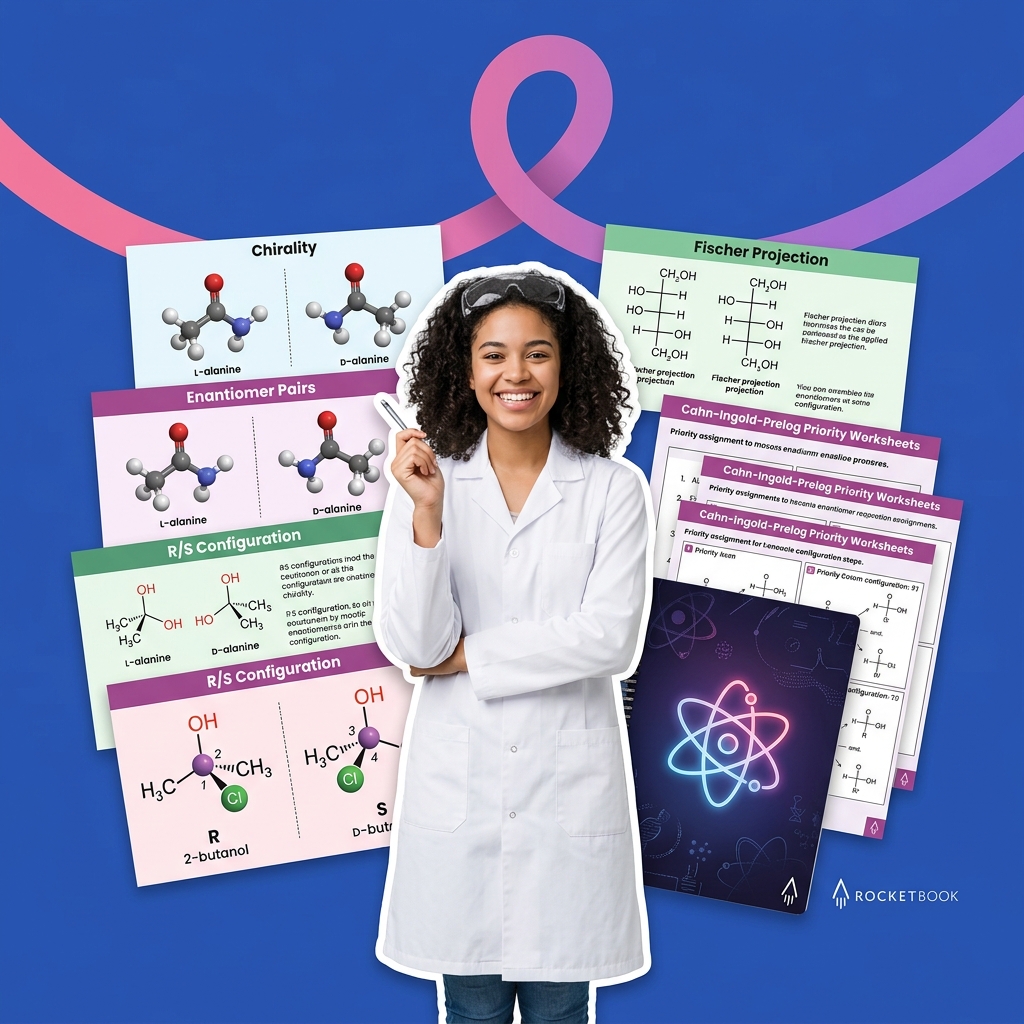
In organic chemistry, stereochemistry is the study of the three-dimensional spatial arrangement of atoms in molecules. A central concept is chirality: a molecule is chiral if it is non-superimposable on its mirror image, much like a person's left and right hands. Chiral molecules typically contain one or more chiral centers (stereocenters)—usually a carbon atom bonded to four different groups. To distinguish between these mirror-image isomers (enantiomers), chemists use the Cahn-Ingold-Prelog (CIP) priority rules to assign an absolute configuration of $R$ (rectus, clockwise) or $S$ (sinister, counterclockwise) to each stereocenter.
Visualizing molecules in 3D and determining priorities on flat paper can be highly challenging. To finish homework assignments quickly, students often upload chemical structures or chemical names to AI tools and ask them to determine whether a molecule is $R$ or $S$. However, copying configurations from AI bypasses the critical spatial reasoning development needed to succeed in organic chemistry courses and on standardized tests like the MCAT. This guide outlines a safe, active-learning study workflow to use AI as a Socratic stereochemistry coach.
Step 1: Identifying Chiral Centers Socraticly
A chiral center is a tetrahedral atom (usually $sp^3$ hybridized carbon) bonded to four unique substituents. Students often make the mistake of classifying carbons in double bonds ($sp^2$) or ring structures incorrectly. Instead of asking AI to point out all chiral carbons in a molecule, use it to check your classification logic.
Prompt the AI to check your chiral center identification using this template:
I am identifying chiral centers in organic molecules. I want to explain why specific carbon atoms in a given structure are chiral or achiral. Act as a Socratic chemistry tutor. Do not list the chiral centers or solve the structure. Ask me to identify the hybridization state and list the four groups bonded to a carbon atom of my choosing. Evaluate my answers and guide me with hints.Step 2: Practicing Cahn-Ingold-Prelog (CIP) Priority Rules
Once a chiral center is identified, the four groups attached to it must be prioritized based on atomic number (higher atomic number gets higher priority). If there is a tie, you compare the atoms bonded to those first atoms, moving outwards along the path until a difference is found. Double and triple bonds are treated as duplicate single bonds.
Practice tracing priority chains Socraticly with this prompt:
I am assigning priorities to the four substituents attached to a chiral carbon: -CH2OH, -CH3, -H, and -OH. Act as a Socratic chemistry coach. Do not list the priorities for me. Ask me to identify the atomic number of the atom directly attached to the chiral center for each group, explain how to resolve ties by looking at the next atoms in the chain, and evaluate my step-by-step priority ranking. Guide me.Step 3: Determining R/S Configurations in 3D Space
After assigning priorities (1 to 4), you must orient the molecule so that the lowest priority group (usually hydrogen, priority 4) is pointing away from you (on a dash). You then trace a circle from priority 1 to 2 to 3. If the circle goes clockwise, the configuration is $R$; if it goes counterclockwise, it is $S$. If the lowest priority group is pointing toward you (on a wedge), the rule is reversed.
Check your spatial configuration logic using this prompt:
I am determining the R/S configuration of a stereocenter. I have assigned priorities 1 to 4, and the lowest priority group (4) is pointing toward me on a wedge. Act as a Socratic chemistry coach. Do not solve the molecule. Ask me to describe the visual pathway from priority 1 to 2 to 3, and explain how to adjust my final assignment when the lowest priority group is on a wedge vs. a dash. Guide me step-by-step.
Rocketbook Smart Reusable Notebook
Eco-friendly, reusable physical notebook that digitizes and syncs your hand-written diagrams and notes directly to your favorite cloud storage for AI-assisted study.
AI Study Pilot receives a small commission from qualifying Amazon purchases at no extra cost to you.Common mistakes
Keep these pitfalls in mind when studying stereochemistry:
- Ignoring double bonds in priority rules: When comparing chains, double bonds are treated as two single bonds to the same atom. For example, a carbonyl carbon (-CH=O) is treated as a carbon bonded to (O, O, H) rather than just (O, H). AI engines frequently misinterpret double-bond duplicates. Ask AI to check your understanding: "Socraticly quiz me on how to treat double and triple bonds when determining substituent priority. Guide me."
- Forgetting that a molecule can have chiral centers but be achiral: Meso compounds contain stereocenters but also possess an internal plane of symmetry, making them overall achiral (optically inactive). AI tools often fail to spot internal planes of symmetry in complex rings.
- Getting disoriented by Fischer projections: In a Fischer projection, horizontal lines represent bonds coming toward you (wedges) and vertical lines represent bonds going away from you (dashes). Always trace your R/S configuration by remembering this orientation.
FAQ
- What is the difference between enantiomers and diastereomers? Enantiomers are non-superimposable mirror images (all stereocenters are inverted). Diastereomers are non-superimposable non-mirror images (some, but not all, stereocenters are inverted). Prompt the AI: "Socraticly quiz me on how to tell if a pair of stereoisomers are enantiomers, diastereomers, or the same molecule. Guide me."
- How does stereochemistry affect drug action? Receptors are chiral, so different enantiomers of a drug can have vastly different biological activities. Prompt: "Socraticly quiz me on how stereochemistry affects pharmaceutical drug interactions, using the classic example of thalidomide."
- How do I identify a meso compound? A meso compound has a plane of symmetry and is superimposable on its mirror image despite having chiral centers. Prompt: "Socraticly quiz me on how to find a plane of symmetry in cis-1,2-dimethylcyclohexane to prove it is a meso compound."
Final recommendation
Stereochemistry is a spatial puzzle. Do not rely on AI text predictions to do the 3D rotation for you. Instead, sketch chemical structures on paper, trace atom-by-atom priorities manually, and use Socratic AI checkpoints to audit your priority chains, wedge/dash conventions, and symmetry checks.
Disclosure: AI Study Pilot may add affiliate links later. We recommend free-first tools where possible and never promise guaranteed grades or outcomes.