Chemistry & pre-med · Updated June 2026
How to Design Organic Synthesis and Retrosynthetic Pathways With AI Safely
Master organic chemistry synthesis and retrosynthesis using Socratic AI coaching to map synthetic steps, nucleophile-electrophile pairings, and retro-reactions safely.
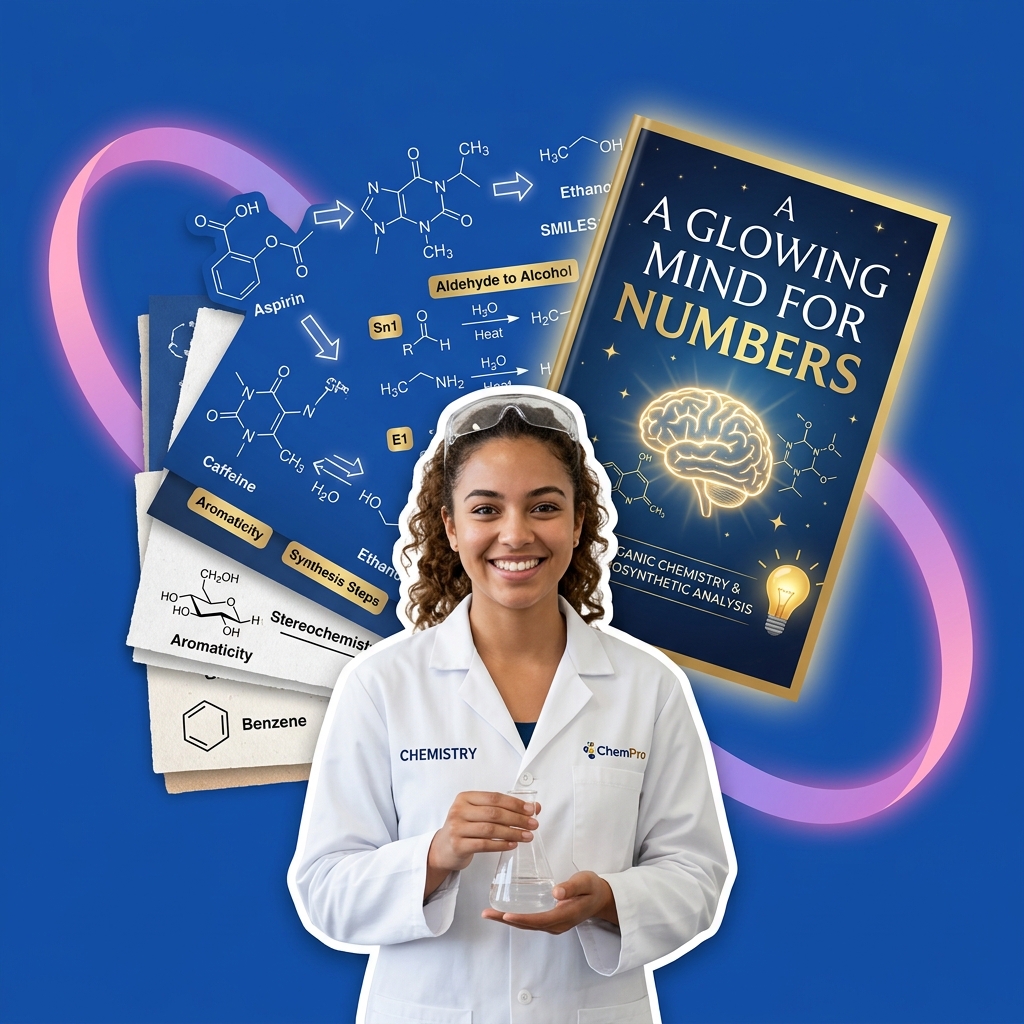
Designing a multi-step organic synthesis is one of the most challenging skills in college chemistry. Rather than simply predicting the product of a single reaction, you must work backward from a target molecule to simple, commercially available starting materials—a process known as retrosynthetic analysis. Because synthesis planning requires a deep mental catalog of reactions and mechanisms, it is tempting to paste target molecules into an AI tool and ask it to write the synthetic steps for you.
However, letting AI plan retrosynthetic pathways for you prevents you from building the strategic problem-solving and diagnostic skills required to succeed in advanced chemistry exams and research laboratories. This guide outlines a safe, active-learning study workflow to use AI as a Socratic synthesis mentor to master organic synthesis and retrosynthetic planning.
Step 1: Mapping the Retrosynthetic Disconnection Socraticly
A retrosynthetic pathway starts by identifying a strategic bond to disconnect in the target molecule. This disconnection reveals simpler precursor fragments (synthons) and helps you choose the final chemical reaction in the sequence. Instead of asking AI where to disconnect the molecule, use it to check your strategic logic.
Set up a disconnection check using this prompt:
I am practicing retrosynthetic analysis. My target molecule is 2-phenylethanol. I want to plan its synthesis starting from benzene and ethylene oxide. Act as a Socratic organic chemistry tutor. Do not write the synthesis steps or list the disconnections. Ask me to identify the functional groups present in the target molecule and suggest a bond to disconnect that would simplify the structure. Evaluate my suggestions and guide me with hints.Step 2: Formulating Synthetic Precursors and Reagents
Once you have disconnected a bond, you must identify the actual chemical reagents (synthetic equivalents) that correspond to the theoretical synthons. For instance, if you disconnect a carbon-carbon bond next to a carbonyl, you might use a Grignard reagent as a nucleophilic carbon source.
Practice selecting reagents with this prompt:
I am designing a synthesis for 2-phenylethanol. I disconnected the bond between the alpha carbon and the phenyl ring, yielding a phenyl nucleophile synthon and a 2-hydroxyethyl electrophile synthon. I plan to use phenylmagnesium bromide (a Grignard reagent) as my nucleophilic precursor. Act as a Socratic organic chemistry coach. Do not tell me what electrophile reagent to use or list the steps. Ask me to identify the appropriate electrophile reagent that will react with the Grignard reagent to produce the alcohol, and ask me to write the reaction conditions. Guide me with hints.Step 3: Checking Functional Group Compatibility and Selectivity
In multi-step synthesis, you must verify that reagents used in later steps do not unintentionally react with other functional groups in the molecule. This requires analyzing chemoselectivity, regioselectivity, and stereoselectivity.
Check your pathway's compatibility using this prompt:
I am proposing a three-step synthesis: 1. Bromination of toluene to form benzyl bromide. 2. Reaction with sodium cyanide to form phenylacetonitrile. 3. Reduction using lithium aluminum hydride (LiAlH4) to form 2-phenylethanamine. Act as a Socratic chemistry instructor. Review my proposed pathway. Ask me to verify if LiAlH4 is selective enough for my reduction step, and ask if any competing reactions or compatibility issues might occur. Guide me with hints to refine my pathway.
A Mind for Numbers: How to Excel at Math and Science
Dr. Barbara Oakley's actionable guide to unlocking analytical thinking. Perfect for students tackling STEM classes who want to beat procrastination and master complex formulas.
AI Study Pilot receives a small commission from qualifying Amazon purchases at no extra cost to you.Common mistakes
Keep these pitfalls in mind when using AI for organic chemistry synthesis:
- Ignoring side reactions: AI models often propose "ideal" textbook reactions that fail in practice due to steric hindrance, competing elimination (E2 vs. SN2) pathways, or over-reduction. Always ask the AI: "Are there any competing reactions (like elimination or rearrangement) that might lower the yield of my proposed step? Guide me Socraticly to audit it."
- Over-relying on linear pathways: Convergent synthesis (joining two mid-sized molecules) is often much more efficient than linear synthesis (adding one carbon at a time). Use AI to evaluate your strategy: "I want to compare a linear synthesis vs. a convergent synthesis for my target molecule. Ask me questions about step yields and overall efficiency to guide my analysis."
- Pasting IUPAC names without verifying structures: AI models can easily mismatch complex IUPAC names. Always write out simplified chemical descriptions or step-by-step structural connections in your prompts to ensure accuracy.
FAQ
- How can I use AI to study functional group interconversions (FGI)? FGI is the process of converting one functional group into another (e.g., alcohol to aldehyde). Ask the AI: "Act as a Socratic chemistry coach. Quiz me on the reagents needed to perform key functional group interconversions. Present one FGI at a time and guide me with hints."
- Can AI help me study protecting group chemistry? Yes. If your target molecule has multiple reactive sites, you must protect one. Prompt: "Help me identify if my proposed synthesis pathway requires a protecting group (e.g., silyl ethers for alcohols). Do not give the answer; ask me about the reactivity of my reagents in step 2 to guide me."
- How do I verify stereochemical outcomes in my synthesis? If your reaction creates a chiral center, you must track if it forms a racemic mixture or a single enantiomer. Ask AI to prompt you on the reaction mechanism (e.g., SN1 vs. SN2) to determine the stereochemical outcome.
Final recommendation
Retrosynthetic planning is a puzzle that develops your chemical design skills. Sketch out your disconnections using retrosynthetic arrows on paper, write your forward reactions clearly in a chemistry notebook, and use Socratic AI checkpoints to audit your reagent compatibility and functional group selectivity.
Disclosure: AI Study Pilot may add affiliate links later. We recommend free-first tools where possible and never promise guaranteed grades or outcomes.