Physics · Updated June 2026
How to Learn Electromagnetic Induction and Master Faraday's Law with AI Safely
Master magnetic flux calculations, Faraday's law, Lenz's law directions, motional EMF, and self-inductance using Socratic AI coaching safely.
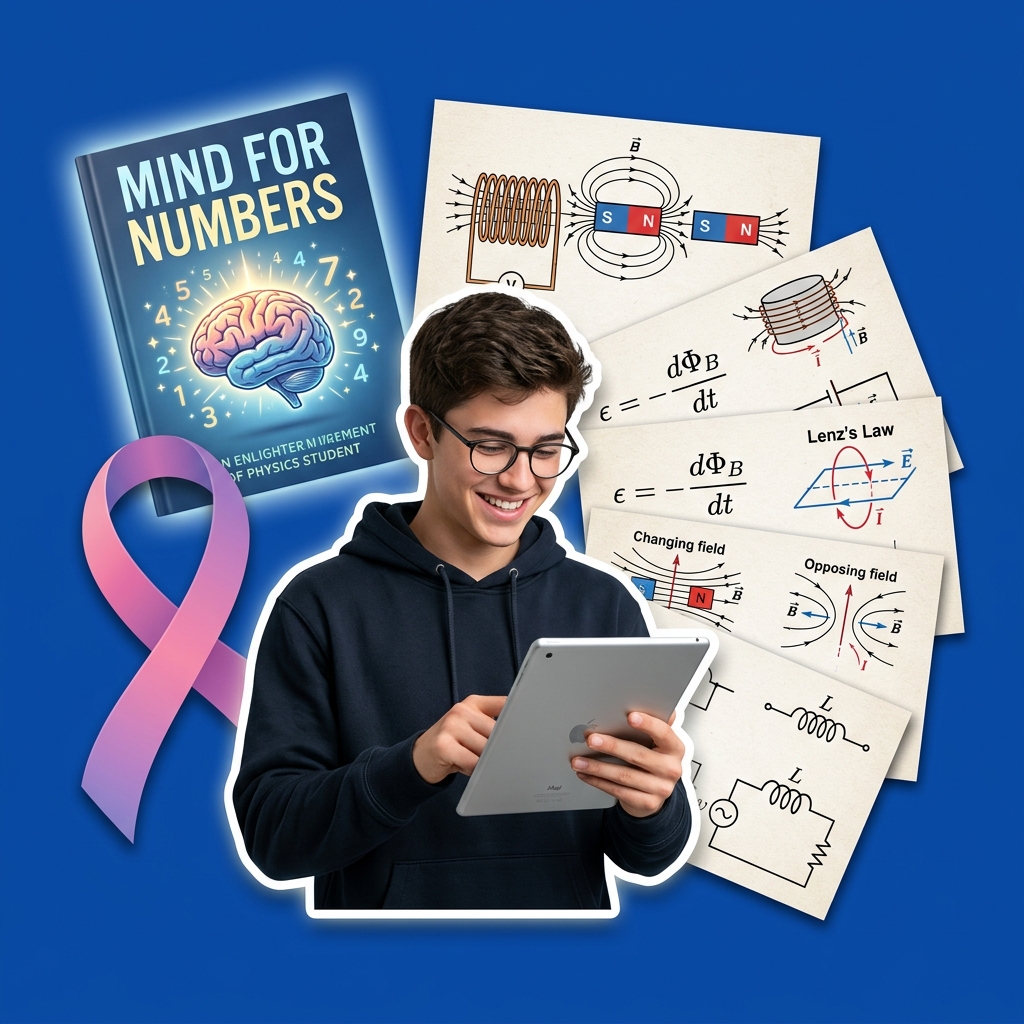
In electromagnetism and electrical engineering, Electromagnetic Induction is the physical process by which a changing magnetic field induces an electromotive force (EMF) or voltage across a electrical conductor. Discovered independently by Michael Faraday and Joseph Henry, induction is the fundamental principle that drives power grids, electric generators, transformers, inductors, and wireless charging systems.
The mathematics and physics of induction rest on three pillars:
- Magnetic Flux (\(\Phi_B\)): A measure of the total magnetic field passing through a given surface area, defined mathematically as:
\[\Phi_B = \mathbf{B} \cdot \mathbf{A} = B A \cos(\theta)\]
where \(B\) is the magnetic field strength, \(A\) is the loop area, and \(\theta\) is the angle between the magnetic field lines and the normal (perpendicular) to the loop surface.
- Faraday's Law of Induction: States that the induced electromotive force (EMF, \(\mathcal{E}\)) in a closed loop is directly proportional to the time rate of change of the magnetic flux through the loop:
\[\mathcal{E} = -N \frac{d\Phi_B}{dt}\]
where \(N\) is the number of turns in a wire coil.
- Lenz's Law: Represented by the negative sign in Faraday's equation, Lenz's law states that the direction of the induced current will always create an opposing magnetic field that resists the change in the original magnetic flux that created it.
Because calculating changing fluxes and visualizing three-dimensional vector cross-products (using right-hand rules) is mathematically demanding, students frequently ask AI models to compute induced voltages, identify current directions, or solve circuit equations directly. However, letting AI solve these vector directions and integrals for you prevents you from developing the spatial visualization skills needed to design inductors, analyze electric motors, or troubleshoot electromagnetic interference. This guide outlines a Socratic workflow to utilize AI as an electromagnetism coach.
Step 1: Mapping Magnetic Flux Calculations Socraticly
To calculate induced EMF, you must first calculate the magnetic flux. Flux can change in three distinct ways: by changing the magnetic field strength \(B\), by changing the loop area \(A\) (e.g., pulling or stretching a loop), or by rotating the loop relative to the field (\(\theta\)).
Using AI to solve these integrals and dot products directly deprives you of learning how to map geometric coordinates to electromagnetic vector equations.
Use this Socratic prompt to check your magnetic flux calculations:
I am calculating the magnetic flux through a circular loop of wire that is rotating at a constant angular velocity in a uniform magnetic field. Act as a Socratic physics tutor. Do not write the equation or calculate the flux. Ask me to identify which variables in the flux formula are changing over time. Prompt me to express the angle theta as a function of time. Guide me.Step 2: Formulating Lenz's Law and Induced Current Directions Socraticly
Lenz's law is a direct consequence of the conservation of energy. To find the direction of an induced current:
- Identify if the magnetic flux is increasing or decreasing.
- Determine the direction of the opposing magnetic field (\(B_{\text{induced}}\)) needed to resist this change.
- Apply the Right-Hand Rule (point your thumb in the direction of \(B_{\text{induced}}\), and your fingers will curl in the direction of the induced current).
Allowing AI to tell you the current direction directly prevents you from developing the three-dimensional spatial reasoning needed for electromagnetic fields.
Use this prompt to master Lenz's law Socraticly:
I am dropping a bar magnet (north pole facing down) through a stationary horizontal copper ring. Act as a Socratic physics coach. Do not tell me the direction of the induced current. Ask me to explain whether the magnetic flux through the ring is increasing or decreasing as the magnet approaches. Prompt me to determine the direction of the induced magnetic field needed to oppose this change, and guide me to apply the right-hand rule. Guide me.Step 3: Auditing Motional EMF and Inductance Socraticly
When a conducting bar moves through a magnetic field, the free charges in the conductor experience a magnetic force ($F = qvB$), causing them to separate and establish an electric field. This creates a voltage called Motional EMF (\(\mathcal{E} = BLv\)). Similarly, a changing current in a coil induces an EMF in the coil itself—a property called Self-Inductance (\(L\)).
Use this Socratic prompt to check your motional EMF and inductor timing calculations:
I am analyzing a metal rod sliding on two parallel conducting rails through a perpendicular magnetic field, forming a complete loop. Act as a Socratic physics tutor. Do not write the formulas or solve for the induced current. Ask me to explain how the movement of the rod changes the area of the loop, and prompt me to derive the induced EMF using Faraday's law. Guide me.
A Mind for Numbers: How to Excel at Math and Science
Dr. Barbara Oakley's actionable guide to unlocking analytical thinking. Perfect for students tackling STEM classes who want to beat procrastination and master complex formulas.
AI Study Pilot receives a small commission from qualifying Amazon purchases at no extra cost to you.Common mistakes
Be on the lookout for these classic pitfalls when studying induction:
- Misapplying Lenz's Law Directions: A common student error is assuming the induced magnetic field always points in the opposite direction of the external magnetic field. In reality, the induced field only opposes the change in flux. If the flux is decreasing, the induced field points in the same direction as the external field to try to keep it constant.
- Forgetting the Normal Vector Angle: When calculating flux (\(\Phi_B = B A \cos\theta\)), the angle \(\theta\) is measured between the magnetic field lines and the vector normal (perpendicular) to the loop's surface, not the loop's flat plane itself. If the field is parallel to the loop's plane, \(\theta = 90^\circ\) and the flux is zero. Ask AI: "Quiz me Socraticly on the geometric relationships of loop orientations and flux calculations. Guide me."
- Treating Inductors as Open Circuits: Inductors resist rapid changes in current (\(V_L = L \frac{di}{dt}\)). At the exact moment a switch is closed (\(t=0\)), an inductor acts as an open circuit (blocking all current). After a long time (\(t\to\infty\)), it acts as a simple short circuit (offering zero resistance to constant DC). Ask AI: "Socraticly quiz me on inductor behaviors during transient switch states in RL circuits. Guide me."
FAQ
- How does Faraday's law drive electric generators? An electric generator uses mechanical energy (like steam or wind) to rotate a coil of wire inside a permanent magnetic field. As the coil rotates, the angle \(\theta\) changes continuously, producing a sinusoidal changing flux that induces alternating current (AC). Prompt: "Act as a Socratic electrical engineering tutor. Quiz me on the physics of generator loops and how mechanical rotation translates to alternating voltage waves. Guide me."
- What is the difference between self-inductance and mutual-inductance? Self-inductance (\(L\)) is when a changing current in a circuit induces an EMF in that same circuit. Mutual-inductance (\(M\)) is when a changing current in one circuit induces an EMF in a neighboring circuit (the operating principle of electrical transformers). Prompt: "Socraticly guide me to compare the coupling coefficient and flux sharing in mutual-inductance systems. Guide me."
- Why do eddy currents form in solid conductors? When a solid piece of metal moves through a magnetic field, the changing flux induces loops of electrical current (eddy currents) within the metal itself. These currents generate magnetic fields that oppose the motion, causing electromagnetic braking and heating. Prompt: "Quiz me Socraticly on how transformer cores reduce eddy current losses using laminated sheets. Guide me."
Final recommendation
Electromagnetic induction is the bridge that powers our modern world. Do not delegate your flux integrals, current directions, or inductor transient equations to AI. Instead, sketch your loop areas, trace your magnetic vectors, calculate your EMFs manually, and leverage Socratic AI sessions to audit your Lenz's law boundaries, mutual-inductance coupling, and RL circuit timing limits.
Disclosure: AI Study Pilot may add affiliate links later. We recommend free-first tools where possible and never promise guaranteed grades or outcomes.