STEM study · Updated June 2026
How to Learn Electromagnetism and Master Maxwell's Equations With AI Safely
Master electric fields, magnetic induction, and Maxwell's equations with Socratic AI feedback and vector calculus integration drills.

Physics II (Electromagnetism) is notoriously challenging. Unlike mechanics, where you can visualize blocks sliding or projectiles flying, electromagnetism requires visualizing invisible, vector-valued electric and magnetic fields in three-dimensional space. The peak of this challenge is Maxwell's equations, which combine vector calculus, line integrals, and surface integrals.
Many students feel overwhelmed and ask AI engines to calculate answers or derive formulas for them. However, skipping these mathematical derivations prevents you from developing the deep physical intuition required for physics and engineering exams. This guide outlines a safe, conceptual workflow to use AI as a Socratic physics tutor to master Maxwell's equations.
Step 1: Visualizing Gauss's Law and Flux Socraticly
Gauss's law relates the net electric flux through a closed surface to the net enclosed charge. Instead of asking AI to evaluate flux integrals for you, ask it to help you determine the correct shape of a Gaussian surface (spherical, cylindrical, or planar) based on the charge distribution's symmetry.
Set up a Gaussian symmetry check using this prompt:
I am studying Gauss's law and electric flux. I have a problem involving a long, uniformly charged cylinder of radius R. Act as a Socratic physics professor. Do not solve the problem. Ask me questions one at a time to guide me to:
1. Identifying the charge distribution symmetry.
2. Selecting the appropriate Gaussian surface shape.
3. Expressing the electric flux through each part of the surface.
Evaluate my reasoning and guide me with hints.
Step 2: Deriving Faraday's Law and Induced EMF
Faraday's law of induction states that a changing magnetic flux induces an electromotive force (EMF) in a closed loop. Use AI to test your understanding of Lenz's law (which determines the direction of the induced current) and Faraday's equation setup without giving away the final algebra.
Practice induced EMF calculations with this prompt:
I want to practice applying Faraday's law and Lenz's law. Act as a Socratic physics coach. Present me with a scenario involving a wire loop moving through a non-uniform magnetic field. Ask me questions to help me determine the change in magnetic flux, the direction of the induced current, and the setup of the Faraday's law equation. Evaluate my answers and guide me with hints.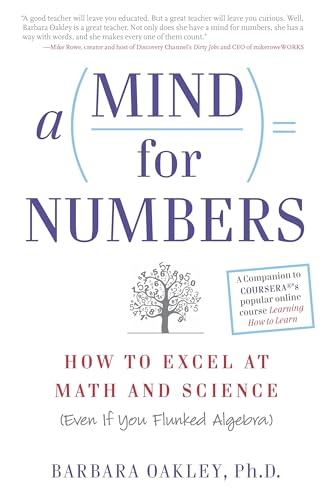
A Mind for Numbers: How to Excel at Math and Science
Dr. Barbara Oakley's actionable guide to unlocking analytical thinking. Perfect for students tackling STEM classes who want to beat procrastination and master complex formulas.
AI Study Pilot receives a small commission from qualifying Amazon purchases at no extra cost to you.Common mistakes
When studying electromagnetism with AI, avoid these common traps:
- Letting AI compute cross products: Magnetic forces ($\vec{F} = q\vec{v} \times \vec{B}$) involve vector cross products. You must practice the right-hand rule and calculate the determinants yourself. Ask AI only to audit your vector sign setups.
- Confusing line and surface integrals: Maxwell's equations use closed line integrals ($\oint \vec{E} \cdot d\vec{l}$) and closed surface integrals ($\oint \vec{E} \cdot d\vec{A}$). Pay close attention to integration boundaries and write them out manually.
- Ignoring boundary conditions: In electromagnetic wave propagation, boundary conditions at the interface of two materials are critical. Always double-check your dielectric constants ($\kappa$ or $\epsilon_r$).
FAQ
- How can I use AI to study Ampere's law? Paste your Ampere's loop scenario and ask: "Is my choice of Ampere's path mathematically appropriate for this current configuration? Guide me through verifying the enclosed current calculation."
- Can AI check my inductance derivations? Yes! Paste your derivation steps for the self-inductance of a solenoid and ask: "Is my step relating flux linkage to current correct, or did I miss a turns-ratio component?"
Final recommendation
Deducing electromagnetic field pathways requires rigorous spatial visualization and vector calculus logic. Practice sketching field lines and Gaussian surfaces on paper or a smart reusable notes canvas, and use Socratic AI checkpoints to audit your physical logic.
Disclosure: AI Study Pilot may add affiliate links later. We recommend free-first tools where possible and never promise guaranteed grades or outcomes.