Subject workflow · Political science
Use AI to Study Political Science Policy Briefs Without Outsourcing Your Analysis
A student-safe workflow for reading policy briefs with AI while keeping your argument, evidence, and analysis your own.
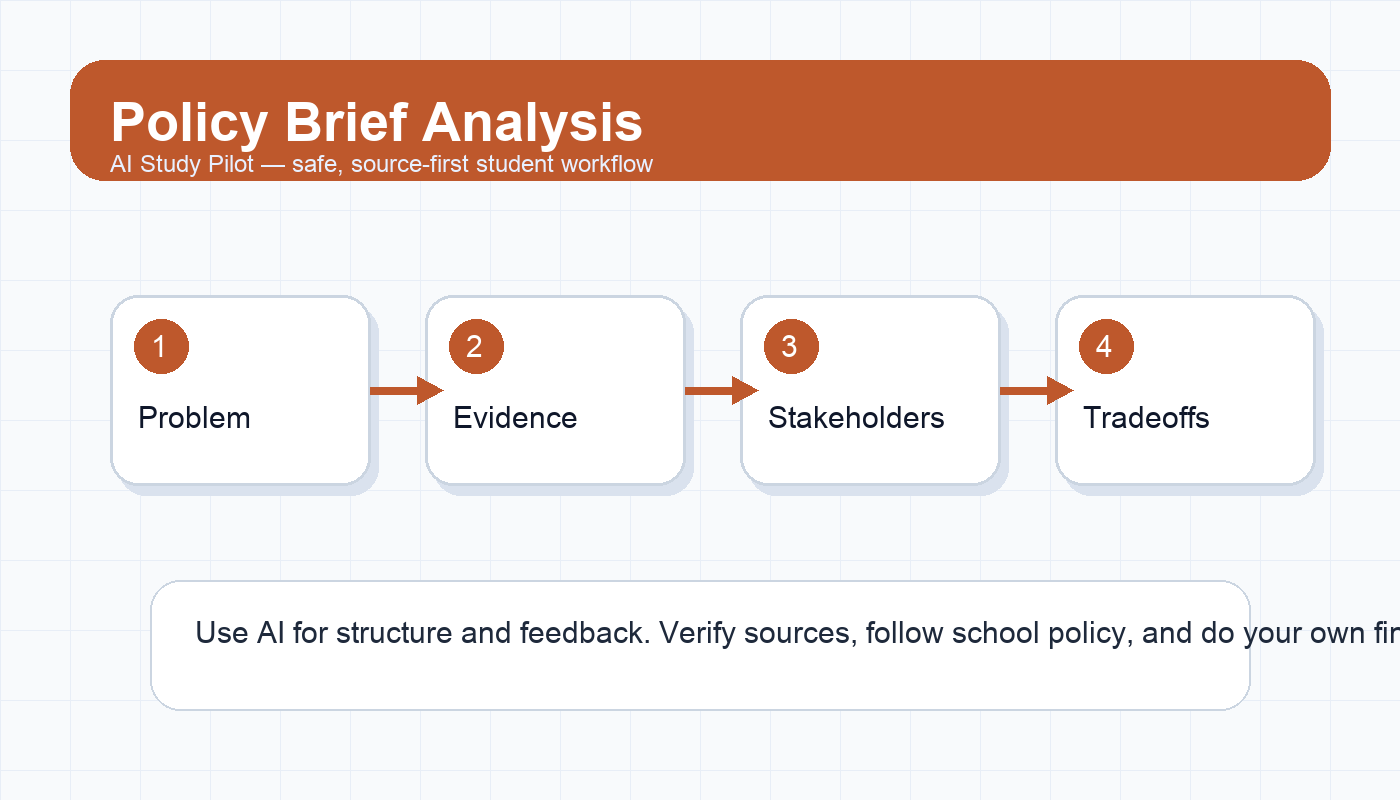
Quick answer
You can use AI to study political science policy briefs by asking it to help structure the document: problem, policy proposal, stakeholders, evidence, assumptions, tradeoffs, and unanswered questions. The safe boundary is clear: AI can help you understand and pressure-test a brief, but your final position, evidence selection, and written analysis should be your own.
A good workflow looks like this:
- Read the brief once yourself and mark the thesis, recommendation, and evidence.
- Ask AI to create a neutral policy-brief map from the text or your notes.
- Verify every claim against the original source.
- Use AI to generate questions, counterarguments, and stakeholder perspectives.
- Write your own analysis using cited evidence, not AI’s unsupported wording.
This is a humanities/social-science subject workflow, not a deep-STEM problem-solver page. If you are writing a broader research paper, pair it with the AI source evaluation checklist and the AI literature synthesis matrix.
Academic-integrity boundary
Policy analysis is graded on your reasoning. Do not ask AI to write a position paper, fabricate citations, or decide your argument for you. Use it for reading support, structure, practice questions, and critique. If your instructor has rules about AI, follow them.
Safe uses:
- outlining the structure of a brief;
- identifying stakeholder groups;
- turning your notes into study questions;
- asking what evidence would strengthen or weaken a claim;
- comparing policy tradeoffs after you read the source.
Unsafe uses:
- submitting AI-generated analysis as your own;
- citing sources you have not opened;
- using AI to create fake quotes or data;
- hiding AI use when disclosure is required.
For general boundaries, see Is it cheating to use AI for schoolwork?.
What makes policy briefs difficult
Policy briefs are short, but they are dense. They often compress a large debate into a few pages, assume background knowledge, and use persuasive framing. Students can miss the difference between:
- the public problem;
- the author’s preferred solution;
- the evidence offered;
- the political feasibility claim;
- the tradeoff the author downplays;
- the stakeholder who benefits or loses.
AI can help you make those layers visible. But it can also flatten nuance if you let it summarize too quickly. Your job is to keep returning to the original document.
Copy-ready prompt: neutral policy-brief map
You are my political science study assistant. I will paste my notes or excerpts from a policy brief. Help me understand the brief without writing my assignment for me.

Rules:
- Use only the text or notes I provide.
- Do not invent statistics, citations, authors, or policy outcomes.
- Separate the author’s claims from your interpretation.
- Mark uncertainty as CHECK SOURCE.
- Do not write my final argument.

Output:
1. Policy problem in one sentence.
2. Author’s recommended action.
3. Evidence used to support the recommendation.
4. Stakeholders affected.
5. Assumptions the brief depends on.
6. Tradeoffs or risks.
7. Questions I should bring to class or office hours.
Step 1: identify the policy problem
Start with the problem statement. Policy briefs often frame the problem in a way that points toward a preferred solution. Ask:
- What condition is described as a problem?
- Who says it is a problem?
- What evidence shows scale, urgency, or harm?
- Are alternative definitions possible?
AI can rephrase the problem in plain language, but you should compare the wording to the original. A subtle change in wording can change the politics. “Rising costs,” “underinvestment,” and “market failure” can point toward different solutions.
Step 2: separate recommendation from evidence
Students often write “the brief proves that…” when the brief only argues. Build a two-column map:
- Claim or recommendation.
- Evidence offered.
Then add a third column: “How strong is the evidence?” This keeps you from treating every confident sentence as equally supported.
Prompt:
Create a claim-evidence-strength table from my notes. For each claim, identify what evidence supports it and rate the support as strong, moderate, weak, or unclear. Explain the rating in one sentence and mark anything that needs source checking.The rating is not final truth. It is a study aid that helps you decide what to verify.
Step 3: map stakeholders
A policy brief is easier to analyze when you can see the affected groups. Stakeholders may include:
- government agencies;
- voters or residents;
- businesses;
- workers;
- schools;
- patients;
- advocacy groups;
- taxpayers;
- future generations.
Ask AI for a stakeholder map, then challenge it. Who is missing? Who has concentrated benefits? Who has diffuse costs? Who has power to block implementation?
Step 4: test tradeoffs and assumptions
Good policy analysis does not only repeat the recommendation. It names tradeoffs. Use AI to generate questions like:
- What must be true for this policy to work?
- What implementation problem could weaken it?
- Which stakeholder might oppose it and why?
- What metric would show success or failure?
- What unintended consequence is plausible?
Do not let AI answer with fake certainty. Ask it to label speculation clearly.
Step 5: prepare your own discussion or paper outline
After mapping the brief, write your own position. You can ask AI to critique your outline, not replace it:
Here is my own policy analysis outline. Critique it as a tutor. Tell me where my claim is unclear, where I need stronger evidence, what counterargument I should address, and what source I need to re-check. Do not rewrite the paper for me.This is similar to using Claude for academic writing feedback: feedback is safer than ghostwriting.
Policy brief study checklist
- Did I read the brief before asking AI for help?
- Can I state the policy problem without copying the author’s framing?
- Did I separate claims from evidence?
- Did I identify who benefits, who pays, and who decides?
- Did I mark assumptions and tradeoffs?
- Did I verify statistics, dates, and citations?
- Is my final argument written in my voice?
- Did I disclose AI use if required?
Common mistakes
- Treating the brief as neutral. Policy briefs are often persuasive documents.
- Letting AI choose your argument. Your reasoning is the assessed work.
- Ignoring implementation. A policy can sound good and still be hard to execute.
- Forgetting stakeholders. Politics is about interests, power, and tradeoffs.
- Citing AI instead of sources. Cite the brief, data, or scholarship you verified.
FAQ
Can AI help me compare two policy briefs?
Yes. Ask for a comparison of problem framing, evidence, stakeholders, assumptions, and tradeoffs. Verify both documents before using the comparison.
Can I ask AI for counterarguments?
Yes, if you use them to think more critically and then write your own response. Ask AI to label counterarguments as possibilities, not facts.
What if the brief includes statistics?
Check the original data source when possible. AI can misread numbers or strip context, especially when statistics are in charts, footnotes, or appendices.
Final recommendation
Use AI as a policy reading coach: map the brief, pressure-test the claims, and prepare better questions. Keep the final analysis grounded in verified evidence and your own judgment.
Disclosure: AI Study Pilot may add affiliate links later. We recommend free-first tools where possible and never promise guaranteed grades or outcomes.