Probability & Statistics · Updated June 2026
How to Learn Bayes' Theorem and Master Conditional Probability with AI Safely
Master conditional probability equations, prior/posterior updates, the law of total probability, and Bayes' theorem calculations using Socratic AI coaching to build statistical intuition safely.

In probability theory, statistics, and data science, conditional probability measures the probability of an event occurring given that another event has already occurred. This is written as \(P(A|B)\) (the probability of \(A\) given \(B\)).
Bayes' Theorem is the mathematical formula used to update the probability of a hypothesis (\(H\)) based on new evidence (\(E\)):
\[P(H|E) = \frac{P(E|H) \cdot P(H)}{P(E)}\]
Where:
- \(P(H|E)\) is the posterior probability: the probability of the hypothesis given the evidence.
- \(P(E|H)\) is the likelihood: the probability of the evidence given that the hypothesis is true.
- \(P(H)\) is the prior probability: the initial probability of the hypothesis before seeing the evidence.
- \(P(E)\) is the marginal probability: the total probability of the evidence occurring, often computed using the Law of Total Probability: \(P(E) = P(E|H)P(H) + P(E|H^c)P(H^c)\), where \(H^c\) is the complement of the hypothesis.
Because Bayesian calculations involve navigating word problems, tree diagrams, and conditional percentages, students frequently ask AI models to compute posterior probabilities directly. However, relying on AI to solve these equations prevents you from developing the statistical reasoning required to assess risks, evaluate diagnostic test results (e.g., false positives), or build machine learning classifiers (like Naive Bayes). This guide outlines a Socratic workflow to utilize AI as a probability tutor.
Step 1: Mapping Conditional Probability Trees Socraticly
Many Bayesian word problems are easiest to solve by drawing a probability tree. The first set of branches represents the prior probabilities (\(P(H)\) and \(P(H^c)\)), and the second set of branches represents the conditional probabilities (\(P(E|H)\), \(P(E^c|H)\), \(P(E|H^c)\), \(P(E^c|H^c)\)).
Use this Socratic prompt to check your probability tree logic:
I am solving a probability problem: A rare disease affects 1% of the population. A diagnostic test is 99% accurate (true positive rate of 99%, false positive rate of 5%). Act as a Socratic statistics tutor. Do not solve the problem or write equations. Ask me to outline the branches of a probability tree for this scenario. Have me specify the prior probabilities and the conditional probabilities at each branch. Guide me.Step 2: Formulating the Law of Total Probability Socraticly
Before you can compute the posterior probability \(P(H|E)\), you must calculate the total probability of the evidence \(P(E)\). Students often get confused by the denominator in Bayes' theorem because it requires summing the probability of the evidence across all possible mutually exclusive scenarios (the Law of Total Probability).
Using AI to compute the denominator directly deprives you of the mathematical intuition of how common or rare the evidence is across the entire sample space.
Use this prompt to master the Law of Total Probability Socraticly:
I need to calculate the total probability of a positive test result P(Pos) using the Law of Total Probability for the disease problem. Act as a Socratic probability coach. Do not perform the calculation or state the formula. Ask me to explain how to combine the probability of getting a positive test if you have the disease and the probability of getting a positive test if you do not have the disease. Guide me.Step 3: Computing the Posterior & Normalizing Socraticly
Once you have the prior, likelihood, and marginal probability, you calculate the posterior probability. In medical diagnostic testing, students are often shocked to find that even with a highly accurate test (e.g., 99% accurate), the probability that a person who tests positive actually has a rare disease is surprisingly low (due to the false positive rate dominating the tiny prior probability). This is known as the base rate fallacy.
Use this Socratic prompt to check your posterior calculation and interpret the base rate fallacy:
I have calculated the total probability of a positive test. Now I need to calculate the posterior probability P(Disease|Positive). Act as a Socratic statistics tutor. Do not calculate the value. Ask me to state Bayes' theorem using my specific terms, and prompt me to explain why the final probability of actually having the disease is lower than the test's accuracy rating. Guide me.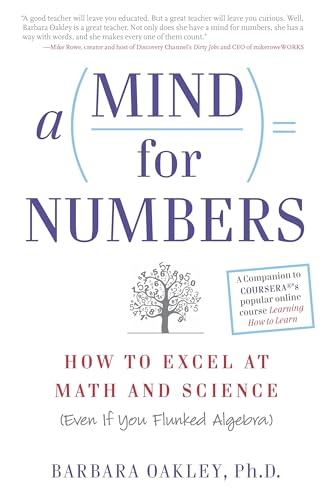
A Mind for Numbers: How to Excel at Math and Science
Dr. Barbara Oakley's actionable guide to unlocking analytical thinking. Perfect for students tackling STEM classes who want to beat procrastination and master complex formulas.
AI Study Pilot receives a small commission from qualifying Amazon purchases at no extra cost to you.Common mistakes
Keep an eye out for these classic pitfalls when studying Bayes' theorem:
- Confusing \(P(A|B)\) with \(P(B|A)\): This is the prosecutor's fallacy. For example, the probability of testing positive given that you have the disease, \(P(\text{Pos}|\text{Disease})\), is very different from the probability of having the disease given that you test positive, \(P(\text{Disease}|\text{Pos})\). AI models often write these conditional statements backward in word problems.
- Forgetting to partition the sample space: When computing \(P(E)\) in the denominator, you must include all mutually exclusive cases that partition the space. If there are three possible suppliers for a factory, the total defect rate is the sum of conditional defect rates weighted by each supplier's prior share.
- Adding probabilities that are not mutually exclusive: When combining probabilities, students often add \(P(A)\) and \(P(B)\) directly without subtracting their intersection \(P(A \cap B)\), violating the addition rule for non-mutually exclusive events. Ask AI: "Quiz me Socraticly on the difference between mutually exclusive events and independent events. Guide me."
FAQ
- What is the difference between prior and posterior probability? The prior is the probability of an event before collecting data or evidence (\(P(H)\)). The posterior is the updated probability after observing the data (\(P(H|E)\)). Prompt: "Socraticly quiz me on how new evidence changes our belief states in a Bayesian framework. Guide me."
- How does Naive Bayes classification use Bayes' theorem? Naive Bayes assumes that features are conditionally independent given the class label, which simplifies the multi-dimensional likelihood calculations in text classification and spam filtering. Prompt: "Act as a Socratic machine learning tutor. Quiz me on why the 'naive' assumption of feature independence is mathematically useful but physically unrealistic. Guide me."
- What is the conjugate prior in Bayesian inference? In Bayesian statistics, if the posterior distribution is in the same probability family as the prior distribution, the prior is called a conjugate prior to the likelihood function, making calculations algebraically convenient. Prompt: "Socraticly quiz me on the concept of conjugate priors and why they are useful in continuous probability updates. Guide me."
Final recommendation
Bayes' theorem is the foundation of scientific updates, machine learning classifiers, and decision theory. Do not delegate your conditional calculations or probability tree designs to AI. Instead, sketch your decision trees, write out your conditional statements with correct order, compute your total probability step-by-step, and leverage Socratic AI sessions to audit your likelihoods, intersections, and base rates.
Disclosure: AI Study Pilot may add affiliate links later. We recommend free-first tools where possible and never promise guaranteed grades or outcomes.