Math & computer science · Updated June 2026
Learn Discrete Mathematics Graph Theory with AI Safely
Master vertex degrees, Eulerian and Hamiltonian paths, and graph coloring algorithms using Socratic AI coaching to analyze network connections and solve discrete math problems safely.
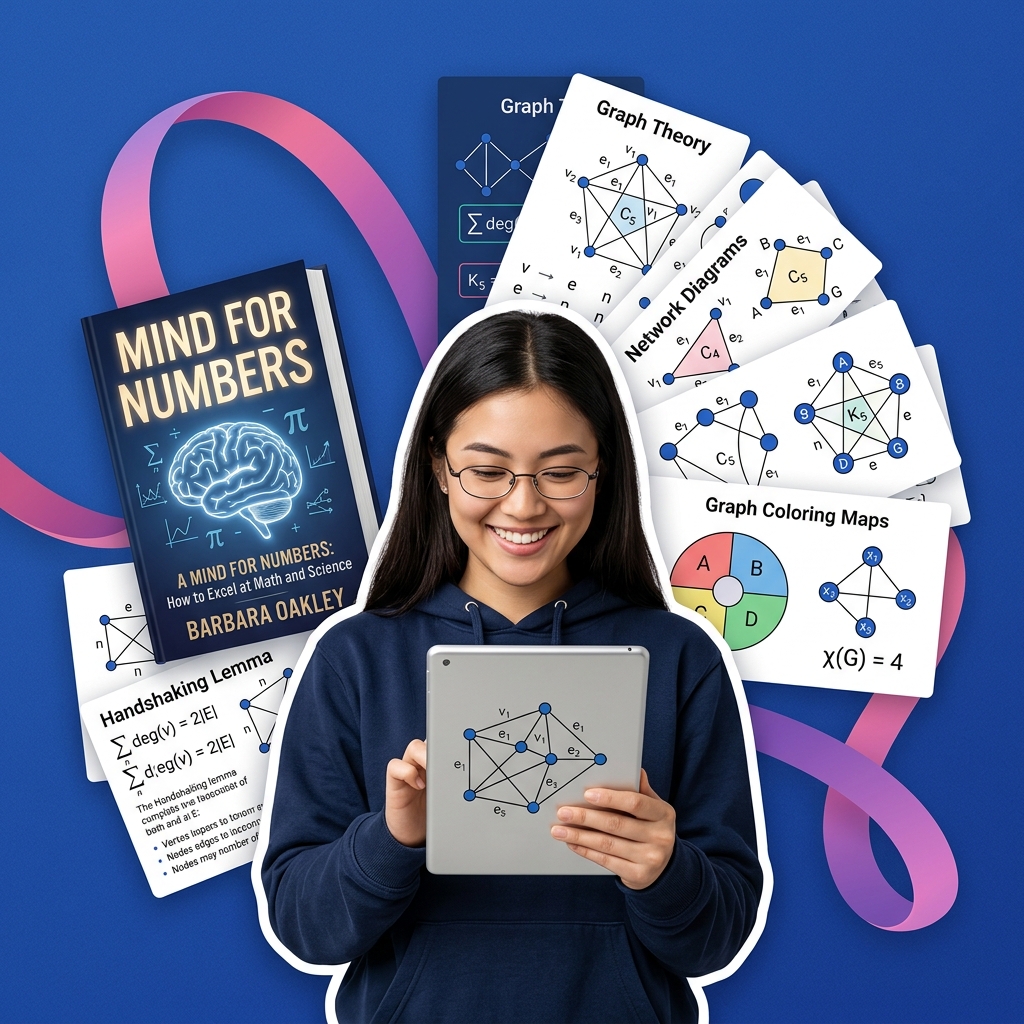
In discrete mathematics and computer science, graph theory is the study of networks. A graph is a mathematical structure consisting of a set of objects called vertices (or nodes) connected by links called edges. Graphs model everything from social network connections and physical internet wiring to compiler data flows and delivery truck routes. Master concepts in graph theory—such as vertex degree calculations, path-finding algorithms, and network coloring—is essential for designing databases, routing algorithms, and analyzing complex data structures.
Because drawing graphs, listing adjacency lists, and tracing paths on complex networks is visually demanding, students often paste adjacency matrices or graph descriptions into AI tools and ask them to trace paths or verify properties. However, relying on AI to solve your network problems prevents you from developing the visual mapping and logical induction skills required to pass discrete mathematics, design algorithms, or write efficient code. This guide outlines a safe, active-learning study workflow to use AI as a Socratic graph theory coach.
Step 1: Applying the Handshaking Lemma
The foundation of vertex degrees is the Handshaking Lemma, which states that in any undirected graph, the sum of the degrees of all vertices is exactly twice the number of edges:
\[\sum_{v \in V} \deg(v) = 2|E|\]
An important consequence of this theorem is that any undirected graph must contain an even number of vertices of odd degree. Rather than asking AI to compute degree sequences, use it to check your proof logic and vertex degree relationships.
Use this prompt to check your degree theorem reasoning Socraticly:
I am proving that it is impossible to have a group of 7 people where each person is friends with exactly 3 others. I want to explain this using the Handshaking Lemma. Act as a Socratic discrete mathematics tutor. Do not write out the proof or solve the equation. Ask me to state the Handshaking Lemma formula, explain what value the sum of vertex degrees would have in this scenario, and evaluate my reasoning on why this violates the lemma. Guide me.Step 2: Differentiating Eulerian and Hamiltonian Paths
A classic source of student confusion is distinguishing between Eulerian and Hamiltonian paths:
- An Eulerian path is a trail in a graph that visits every edge exactly once. An Eulerian circuit is an Eulerian path that starts and ends at the same vertex. A connected graph has an Eulerian circuit if and only if every vertex has an even degree.
- A Hamiltonian path is a path that visits every vertex exactly once. Unlike Eulerian paths, there is no simple characterization (like vertex degrees) to determine if a general graph is Hamiltonian, which makes it a much harder problem (NP-complete).
Practice tracing paths and circuits Socraticly with this prompt:
I am analyzing a connected graph with vertex degrees: A:2, B:3, C:4, D:3. I want to determine if it has an Eulerian path or circuit. Act as a Socratic graph theory coach. Do not tell me the answer. Ask me to count the number of vertices with odd degrees, state Euler's theorem regarding the number of odd-degree vertices allowed for paths versus circuits, and evaluate my conclusion. Guide me.Step 3: Determining Chromatic Numbers via Graph Coloring
Graph coloring is the assignment of labels (colors) to the vertices of a graph such that no two adjacent vertices share the same color. The minimum number of colors needed to color a graph is called its chromatic number (\(\chi(G)\)). Graph coloring has practical applications in scheduling exam times, allocating radio frequencies, and register allocation in compilers.
Check your graph coloring logic Socraticly using this prompt:
I am trying to find the chromatic number of a cycle graph with 5 vertices (C_5). Act as a Socratic discrete math coach. Do not give me the chromatic number. Ask me to define what it means for vertices to be adjacent, prompt me to explain what happens when I alternate colors around a 5-cycle, and ask me to determine why a 2-color scheme fails. Guide me step-by-step.
A Mind for Numbers: How to Excel at Math and Science
Dr. Barbara Oakley's actionable guide to unlocking analytical thinking. Perfect for students tackling STEM classes who want to beat procrastination and master complex formulas.
AI Study Pilot receives a small commission from qualifying Amazon purchases at no extra cost to you.Common mistakes
Be on the lookout for these common graph theory traps:
- Misapplying Euler's path theorems to directed graphs: Undirected and directed graphs have different rules for Eulerian paths. In a directed graph, you must look at in-degrees and out-degrees rather than simple degrees.
- Assuming all planar graphs are 4-colorable without verification: While the famous Four Color Theorem states that any planar map can be colored with at most four colors, non-planar graphs (like \(K_5\), the complete graph on 5 vertices) can have much larger chromatic numbers.
- Confusing walks, paths, and cycles: A walk allows repeated vertices and edges; a path cannot repeat vertices (and thus cannot repeat edges); a cycle is a closed path. Mixing these terms will lead to errors in proofs.
FAQ
- What is a bipartite graph? A bipartite graph is a graph whose vertices can be divided into two disjoint sets such that every edge connects a vertex in one set to a vertex in the other. A graph is bipartite if and only if it contains no odd cycles. Prompt: "Socraticly quiz me on the relation between bipartite graphs and cycle lengths. Ask me to explain how to verify if a given graph is bipartite."
- What is the Königsberg bridge problem? It is the historical puzzle that laid the foundations of graph theory. The goal was to find a walk through the city of Königsberg that crossed each of its seven bridges over the Pregel River exactly once. Leonhard Euler proved it was impossible by modeling the landmasses as vertices and bridges as edges, showing that the resulting multigraph had vertices with odd degrees. Prompt: "Socraticly quiz me on how the Konigsberg bridge puzzle translates to vertex degrees and path tracing."
- What is a tree in graph theory? A tree is an acyclic connected graph. A key property of a tree is that if it has \(n\) vertices, it has exactly \(n-1\) edges. Adding a single edge to a tree creates a cycle. Prompt: "Socraticly quiz me on the definition of a tree and how to prove that adding an edge to a tree always creates a cycle."
Final recommendation
Graph theory is a visual logic framework. Do not rely on text AI outputs to trace cycles or color nodes for you. Instead, sketch your networks on paper, analyze degree sequences step-by-step, and use Socratic AI checkpoints to audit your proofs, path-finding constraints, and chromatic number bounds.
Disclosure: AI Study Pilot may add affiliate links later. We recommend free-first tools where possible and never promise guaranteed grades or outcomes.