STEM study · Updated June 2026
How to Learn Discrete Mathematics and Master Proofs With AI Safely
Learn how to use AI safely to visualize truth tables, understand logic gates, and master mathematical induction with step-by-step Socratic hints.

Discrete mathematics is a gateway course for computer science and mathematics majors, introducing logic, set theory, graph theory, and mathematical proofs. Unlike calculus, which focuses on calculation, discrete math requires abstract reasoning and rigorous logical justification.
For many students, writing their first proofs (such as induction or contradiction) feels like learning a new language. The temptation to paste a homework problem into an AI model and copy the output is high. However, copying proofs destroys your ability to think logically—the exact skill recruiters and professors test.
Instead of using AI to do the work, you can structure it as a Socratic study partner to guide your thinking, verify your steps, and help you visualize complex mathematical concepts safely.
A Safe Socratic Workflow for Discrete Math
Use this three-step workflow to study discrete math concepts conceptually:
1. Socratic Proof Walkthroughs
When you are stuck on a proof, do not ask the AI to write it. Instead, share the theorem you need to prove and ask the AI to provide a Socratic hint or to check your first step. Work through the proof line-by-line, explaining your logical reasoning to the AI and asking it to flag any logical gaps or false assumptions.
2. Truth Table and Logic Visualizations
If you are learning propositional logic, truth tables, or logical equivalences (like De Morgan's laws), ask the AI to explain the equivalence step-by-step or to draw a text-based truth table to verify your manually calculated results.
3. Concept Mapping for Set and Graph Theory
Set theory and graph theory are highly visual. Use AI to generate ASCII-style Venn diagrams or to explain relations (reflexive, symmetric, transitive) with everyday analogies. For graph theory, have the AI describe adjacency matrices or path-finding algorithms (like Dijkstra's) step-by-step.
---
Discrete Math Prompts You Can Copy
Socratic Hint-Based Tutor for Proofs
I am studying discrete mathematics and trying to write a proof for the following theorem: [Insert Theorem, e.g., "Prove that the sum of two odd integers is always even"]. Act as a Socratic math tutor. Do not write the proof for me. Instead, ask me questions to guide me toward the first step, and check my logic as I write it out line by line.Logical Equivalence Explainer
Explain the logical equivalence [Insert Formula, e.g., "p ∧ (q ∨ r) ≡ (p ∧ q) ∨ (p ∧ r)"] step-by-step. Use a plain English analogy first, then show a text-based truth table comparing both sides of the equivalence to prove they are identical.Mathematical Induction Step Checker
I am proving a statement by mathematical induction: [Insert Statement, e.g., "1 + 2 + ... + n = n(n+1)/2"]. I have completed the base case for n=1. Here is my inductive step assumption and proof attempt: [Paste Your Work]. Can you review my work for any logical errors or missing steps? Do not write the correct version; just point out where my logic might be weak.---
Common Mistakes to Avoid in Discrete Math
* Failing to Verify AI Definitions: AI models can easily hallucinate definitions of specific mathematical terms, especially in graph theory (where terminology varies between textbooks). Always cross-reference definitions with your course syllabus or textbook.
* Copying Proof Structure Without Understanding: AI-generated proofs may look elegant but can contain subtle logical fallacies (such as circular reasoning). Ensure you can explain every single line of your proof on a blank whiteboard.
* Skipping the Base Case: In induction proofs, students often ask AI to write the inductive step and skip verifying the base case. Always write out and verify your base case first.
---
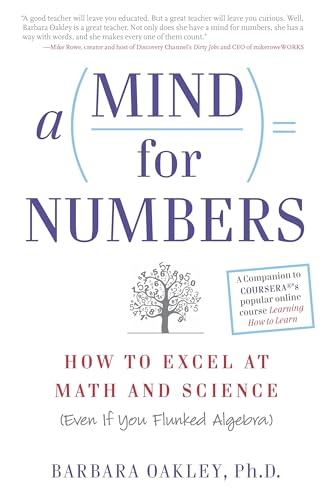
A Mind for Numbers: How to Excel at Math and Science
Dr. Barbara Oakley's actionable guide to unlocking analytical thinking. Perfect for students tackling STEM classes who want to beat procrastination and master complex formulas.
AI Study Pilot receives a small commission from qualifying Amazon purchases at no extra cost to you.FAQ
Can AI write rigorous mathematical proofs?
Advanced LLMs are excellent at writing standard proofs for well-known theorems. However, they struggle with unique or complex problems and frequently introduce logical leaps. Using AI-written proofs for homework is academic dishonesty and leaves you unprepared for exams.
How do I use AI to study set theory?
Ask AI to explain concepts like Cartesian products, power sets, and subsets using practical computer science analogies (such as database joints or bitwise operations).
What is the best way to practice graph theory?
Use AI to generate custom practice problems (e.g., finding Euler paths or verifying bipartite graphs) and ask it to provide a step-by-step hint when you get stuck.
Disclosure: AI Study Pilot may add affiliate links later. We recommend free-first tools where possible and never promise guaranteed grades or outcomes.