Subject workflow · Sociology
How to Study Sociology Theories With AI: Concepts, Examples, and Exam Answers
A sociology study workflow for using AI to compare theories, build examples, practice short answers, and verify claims against assigned readings.
Quick answer
Use AI to study sociology by turning assigned readings into theory maps, everyday examples, comparison tables, and practice short-answer questions. The key is to anchor the model to your course materials. Sociology concepts can be subtle, contested, and context-dependent, so do not let AI flatten a theory into one slogan or invent what an author argued. Use it to practice explaining concepts in your own words, then verify against the reading and lecture notes.
This is a non-STEM subject workflow, focused on honest study. It connects with AI literature analysis, history primary-source analysis, and how to verify AI answers before studying. The same habits work for intro sociology, social theory, criminology, gender studies, education, media, and inequality units.
Why sociology needs careful AI use
Sociology terms often sound familiar in everyday language but have specific course meanings. “Role,” “institution,” “norm,” “capital,” “rationalization,” “deviance,” and “social construction” can mean different things depending on the author and tradition. AI may give a generic definition that is not wrong in general but is wrong for your class.
That is why the workflow starts with the assigned reading. If your professor assigned Durkheim, Weber, Marx, Du Bois, Goffman, Bourdieu, Foucault, Collins, hooks, or contemporary research articles, your answer should reflect that source and lecture framing. AI can help you see the structure, but your evidence must come from the course.
The sociology theory workflow
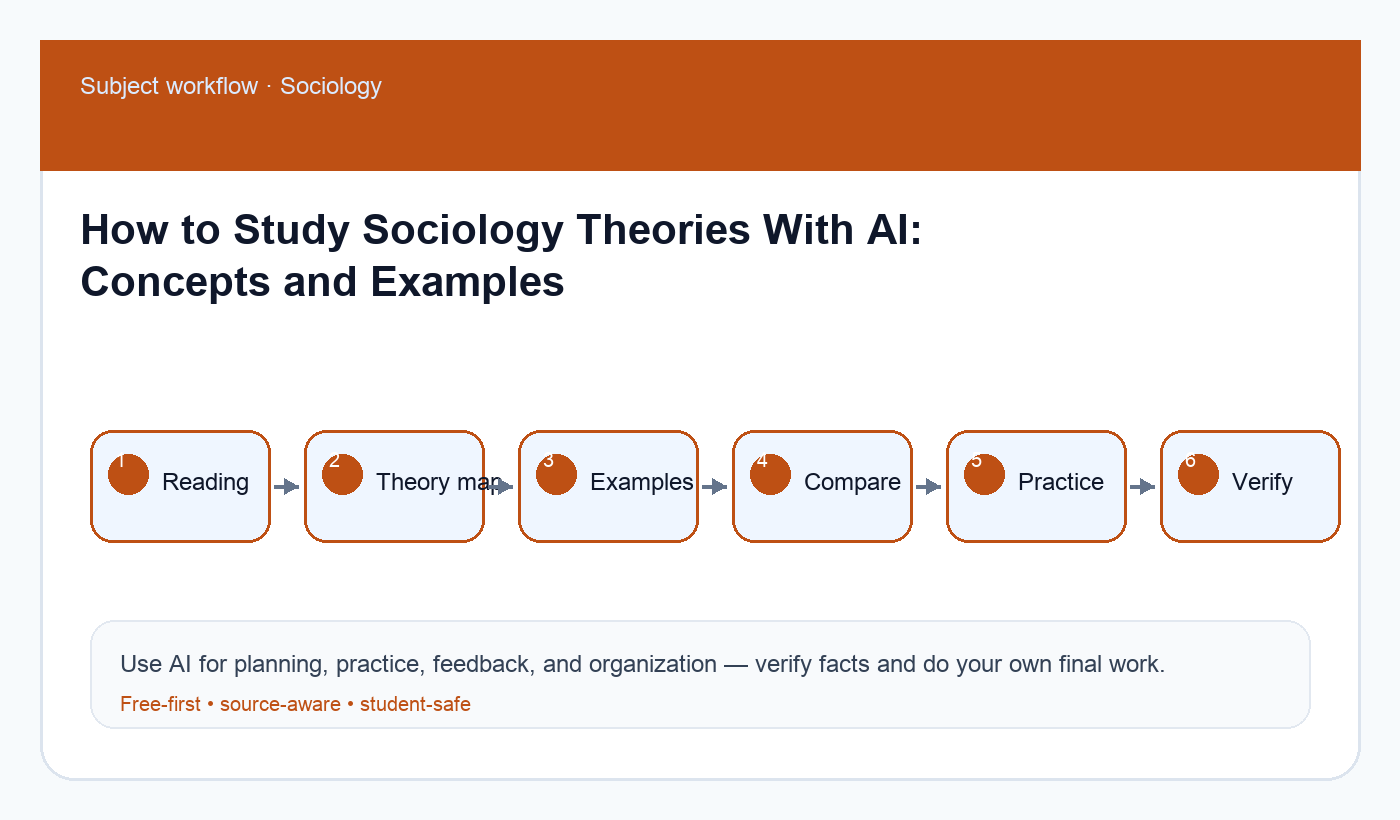
- Stage: Reading capture · Output: Key passages and vocabulary · Verification: Page numbers or lecture dates
- Stage: Theory map · Output: Concepts, assumptions, level of analysis · Verification: Compare with assigned text
- Stage: Everyday example · Output: Concrete case from daily life or news · Verification: Avoid stereotypes and overgeneralization
- Stage: Comparison · Output: Similarities and differences across theories · Verification: Check author-specific claims
- Stage: Practice answer · Output: Short paragraph or exam outline · Verification: Rewrite in your own words
Step 1: capture the reading without replacing it
Read first, even if quickly. Highlight definitions, claims, examples, and passages your instructor emphasized. Then paste a short excerpt or your own notes into AI. Ask it to identify concepts and possible confusion points. Do not ask for a substitute summary of a chapter you never opened if the assignment expects reading.
A good capture note includes: author, reading title, page or section, concept, quote or paraphrase, and your question. That gives AI enough context to help without becoming your only source.
Copy-ready prompt: sociology theory map
Act as a sociology study coach. Use only the reading notes and excerpts I provide. Do not invent author claims, page numbers, research findings, or quotes.

Course topic:
[paste topic]

Reading notes or excerpts:
[paste notes]

Create:
1. A theory map with key concepts and assumptions.
2. Three everyday examples that illustrate the concepts without stereotypes.
3. A comparison with another theory if I provide one.
4. Five practice short-answer questions.
5. A verification checklist showing what I should confirm in the reading.

If something is not supported by my notes, label it CHECK THE READING.
Step 2: build examples carefully
Examples make theory memorable. Ask AI for everyday examples, but screen them. Sociology examples can accidentally become biased, simplistic, or insensitive. Prefer neutral examples like classroom norms, workplace roles, social media interaction, public transportation behavior, housing access, credential requirements, or organizational rules.
Then connect each example back to the concept. Do not stop at “this is an example of socialization.” Explain what is being learned, who enforces the norm, what happens when someone violates it, and which evidence from the reading supports the interpretation.
Step 3: compare theories by level and question
Many exam questions ask you to compare theories. AI can help you build a grid: what does the theory explain, what level does it focus on, what causes change, what does it overlook, and what example fits? A conflict theory answer and a symbolic interactionist answer may both discuss school, but they ask different questions.
Use comparison to avoid vague writing. Instead of “Marx and Weber both studied society,” write what each emphasizes and how the difference changes the explanation. Then check the details against lecture notes.
Step 4: practice exam answers without copying them
Ask AI for short-answer prompts, answer them yourself, then request feedback. The feedback should focus on missing concepts, unsupported claims, unclear examples, and whether your answer names the theorist correctly. Do not submit AI-written paragraphs as your own.
For essay classes, use Claude academic writing feedback as feedback only. Keep your voice and your argument.
Common mistakes
- Trusting a generic definition when your course uses a specific author.
- Using examples that reinforce stereotypes.
- Memorizing theory names without explaining mechanisms.
- Letting AI invent quotes, studies, or page numbers.
- Submitting polished AI prose instead of your own exam answer.
Example: turning one concept into an exam-ready answer
Suppose your notes define socialization as the process through which people learn norms, roles, and expectations. A weak answer says, “Socialization is how people learn society.” A stronger answer names the mechanism, gives a grounded example, and connects it to the reading: “In the classroom, students learn not only subject content but also norms about punctuality, participation, authority, and evaluation. This illustrates socialization because institutions transmit expected behavior through routines, rewards, and sanctions.”
AI can help you practice that move. Ask it to check whether your example names the concept, shows the mechanism, and avoids overclaiming. Then compare the wording to your assigned author or lecture definition.
How to avoid shallow comparison paragraphs
Many sociology essays become lists: one sentence about Theory A, one sentence about Theory B, then a vague conclusion. Instead, compare theories around one shared case. For example, analyze a workplace dress code, a viral social media trend, a school tracking policy, or a neighborhood housing dispute. Ask what each theory highlights and what it misses.
This produces better studying because you are not memorizing isolated definitions. You are practicing the exam skill: selecting a concept, applying it to evidence, and explaining why the lens changes what you see.
Final recommendation
Use AI to turn sociology readings into maps, examples, comparisons, and practice questions. Keep the reading open, verify author-specific claims, and practice explaining concepts in your own language. That is where AI helps learning without replacing it.
Disclosure: AI Study Pilot may add affiliate links later. We recommend free-first tools where possible and never promise guaranteed grades or outcomes.