Support article · Verification
How to Verify AI Answers Before You Study Them
Do not memorize AI mistakes. Use this verification workflow to check answers against notes, sources, examples, and instructor expectations.
Quick answer
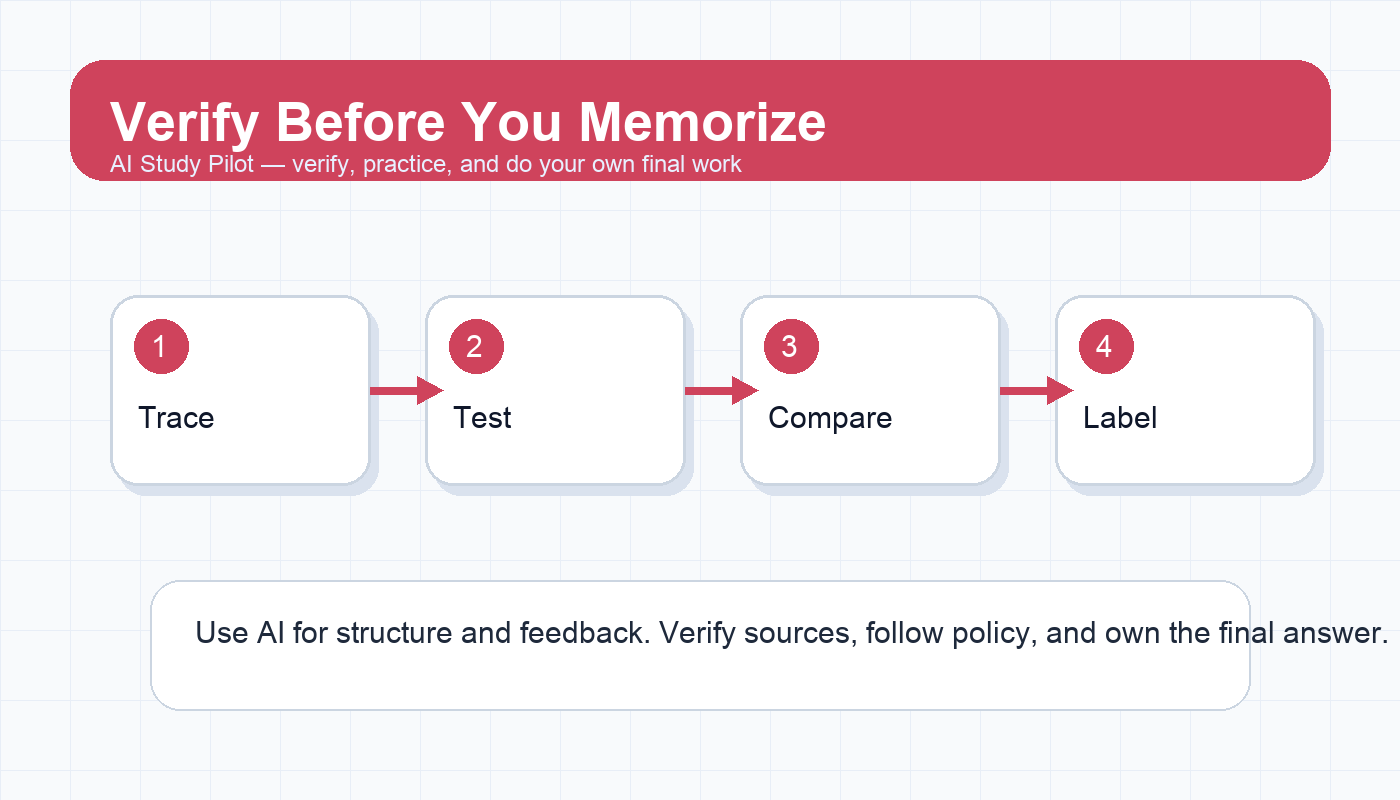
Before you study an AI answer, verify it with a four-step check: trace the answer to your notes or a credible source, test it on a concrete example, compare it against another trusted explanation, and label your confidence. Do not memorize a chatbot response just because it sounds clear. The cost of a wrong study note is high: you may practice the wrong method until it feels familiar.
Use this with the AI hallucination checklist, AI source evaluation checklist, and AI practice exams from notes.
Why verification matters
AI answers often sound complete. That is useful when the answer is right and dangerous when it is wrong. A model can mix two concepts, skip a condition, invent an exception, misquote a source, or explain a method that your instructor does not use. If you turn that answer into flashcards or practice problems, the mistake becomes part of your study system.
Verification does not mean distrusting everything forever. It means separating “good enough to explore” from “safe to memorize.” Students need a quick workflow because most study sessions are time-limited. The goal is to catch major errors before they spread.
The verification ladder
- Level: Unchecked · Meaning: AI said it, but you have not verified it · What to do: Do not memorize yet
- Level: Source-supported · Meaning: Matches notes, reading, data, or credible source · What to do: Study with normal caution
- Level: Example-tested · Meaning: Works on a real example or problem · What to do: Add to practice set
- Level: Instructor-aligned · Meaning: Matches course method or rubric · What to do: Safe for exam prep
Copy-ready prompt: verify this answer
Act as a verification coach. Do not just agree with the AI answer. Help me test whether it is safe to study.

Course/topic:
[paste course]

AI answer I received:
[paste answer]

My trusted source material:
[paste lecture notes, textbook excerpt, rubric, or source link summary]

Please produce:
1. Claims in the AI answer that need verification.
2. Which claims are directly supported by my source material.
3. Any claims that are missing, overstated, or contradicted.
4. One simple example or practice question that would test the answer.
5. A confidence label: unchecked, source-supported, example-tested, or instructor-aligned.

Do not add new facts unless you label them as outside my provided material.
Step 1: trace the answer to a source
Every study-worthy claim should have a home. In a class, the best homes are lecture notes, assigned readings, textbook sections, lab manuals, problem solutions released by the instructor, datasets, or primary sources. For general background, credible educational or scholarly sources can help, but your course still sets the target.
Highlight the AI answer sentence by sentence. Mark each claim as “in my notes,” “in the reading,” “needs source,” or “probably outside scope.” If too many claims are outside scope, the answer may be interesting but not useful for the exam.
Step 2: test with an example
An answer can define a concept correctly and still fail in use. Create one example. In humanities, apply the idea to a passage, image, case, or historical source. In social science, apply it to a scenario or dataset. In math or science, work a small problem and compare steps. In writing, use a sample paragraph and check whether the advice improves clarity without changing your meaning.
If the answer cannot handle an example, do not memorize it yet. Ask your instructor, check another source, or downgrade it to “needs review.”
Step 3: compare against a trusted explanation
Use one trusted comparison: textbook, lecture slide, writing center page, official documentation, library guide, or instructor example. The goal is not to collect ten opinions. The goal is to find contradictions. If the AI answer says a citation needs no page number but your style guide says quotes need page numbers, the style guide wins.
For tool recommendations, compare claims against current product pages. Do not rely on AI for prices, plan limits, or features that change often.
Step 4: label confidence in your notes
Add labels directly in your study document:
- Verified: matches course source.
- Example-tested: worked on a practice example.
- Ask: unclear or disputed.
- Do not memorize: unsupported or possibly wrong.
This small habit keeps your study system honest. It also makes exam review faster because you know which notes are solid and which need instructor clarification.
How this changes flashcards
Do not create flashcards from unchecked AI output. First verify the source, then convert. A bad flashcard is worse than no flashcard because spaced repetition makes it feel true. If you use AI flashcards from notes, paste only verified notes or ask the model to mark uncertain cards as “CHECK.”
Common mistakes
- Asking the same AI tool “are you sure?” and treating the second answer as verification.
- Memorizing a polished explanation before trying a practice example.
- Mixing general internet explanations with course-specific methods.
- Forgetting that product features, laws, statistics, and citation rules can change.
- Keeping unsupported AI notes in the same document as verified notes.
What to do when sources disagree
Sometimes verification finds a real disagreement. Your textbook may use one definition, a website may use another, and the AI answer may blend them. Do not try to force instant certainty. Label the point as “ASK” and write the exact disagreement in your notes. For an exam, your instructor’s framing usually matters most. For a research paper, the disagreement may become a nuance you explain with citations.
When you ask AI about disagreement, give it the two source excerpts and ask it to compare wording, scope, assumptions, and context. Do not ask it to pick a winner without evidence. A careful comparison is more valuable than a confident verdict.
Final recommendation
Verify before you memorize. AI can explain, quiz, organize, and challenge you, but your study materials should be source-supported and example-tested. The best students do not avoid AI entirely; they build a verification habit strong enough to use it without letting errors into exam prep.
Disclosure: AI Study Pilot may add affiliate links later. We recommend free-first tools where possible and never promise guaranteed grades or outcomes.