Workflow · Student productivity
How to Catch Up After Missing Class With AI: A 48-Hour Recovery Plan
A practical 48-hour catch-up workflow for missed class: gather materials, summarize safely, rebuild the lesson, make questions, and plan recovery blocks.
Quick answer
If you missed class, use AI to rebuild the lesson from legitimate materials: syllabus topic, slides, textbook section, a classmate’s notes if they agreed to share, and any recording or transcript your course provides. Ask for a structured catch-up brief, a gap list, office-hours questions, and a 48-hour review plan. Do not ask AI to fabricate what happened in class, impersonate attendance, complete participation work dishonestly, or copy another student’s notes as your own.
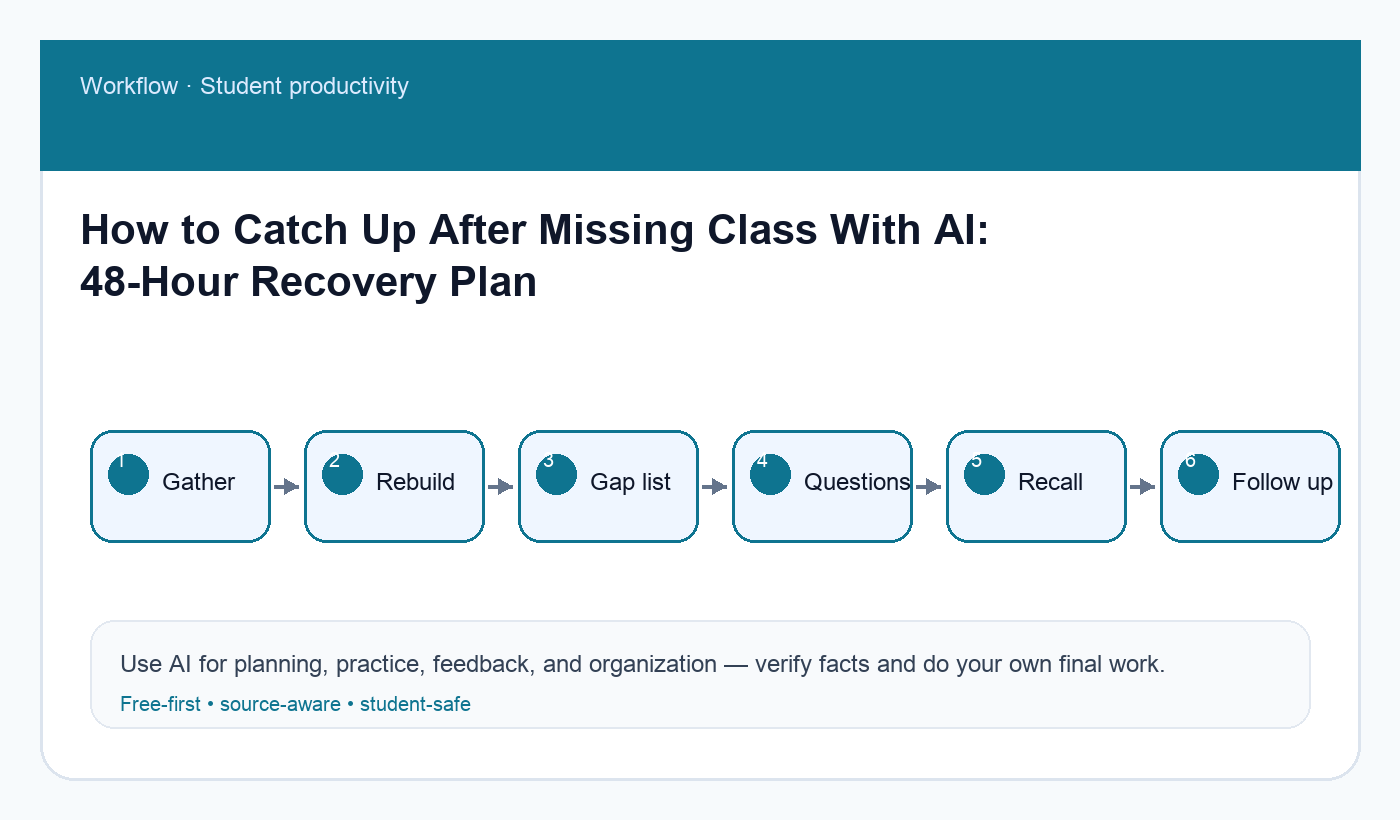
The best catch-up workflow is simple: collect, reconstruct, question, retrieve, and follow up. AI helps you organize the mess quickly, but you still need to verify details and ask your instructor or classmates about anything uncertain. This pairs well with the AI after-class review routine, office-hours question generator, and turn class readings into study blocks.
What AI can and cannot know
AI was not in your classroom. Unless you provide real class materials, it cannot know what your instructor emphasized, what examples were used, what announcements were made, or what quiz hints were given. That is why the workflow below makes uncertainty visible. You want a recovery plan, not a confident hallucination.
Safe uses include summarizing a transcript you are allowed to use, organizing shared notes, explaining the textbook section, drafting polite questions, and building a study block. Unsafe uses include asking for attendance excuses, hidden quiz answers, or a fake account of a discussion you did not attend.
The 48-hour catch-up plan
- Time: First 30 minutes · Goal: Collect real materials · Output: Source pack and uncertainty list
- Time: Hour 1 · Goal: Rebuild the lesson · Output: One-page catch-up brief
- Time: Hour 2 · Goal: Find gaps · Output: Questions for a classmate or instructor
- Time: Next day · Goal: Practice · Output: Recall questions and mini assignment plan
- Time: Before next class · Goal: Rejoin · Output: Prepared notes and follow-up list
Step 1: collect a source pack
Start with what you can legitimately access: syllabus, LMS announcement, slides, assigned reading, lab handout, textbook chapter, public lecture recording, class transcript, or notes a classmate willingly shared. Label each item. If a classmate shares notes, treat them as a guide, not something to copy into your own assignment.
If you have a video, use the YouTube lecture summary workflow or the lecture transcript to outline guide. If you only have slides, ask AI to infer likely teaching points but mark them as guesses until verified.
Step 2: ask AI for a catch-up brief
A good catch-up brief has five parts: what the class was probably about, key terms, worked examples or cases, assignments or deadlines to verify, and questions you still need answered. The brief should be short enough to use before the next class.
Do not let AI turn the brief into false certainty. Require labels: “supported by provided material,” “likely but needs confirmation,” and “missing.” That one instruction protects you from memorizing invented details.
Copy-ready prompt: missed-class recovery
Act as a careful catch-up coach for a student who missed class. Use only the materials I provide. If something is not supported, label it NEEDS CONFIRMATION.

Course:
[paste course name and topic]

Materials I have:
[paste syllabus line, slides, reading notes, transcript, or shared notes]

Create:
1. A one-page catch-up brief.
2. Key terms and examples I should know.
3. A list of unclear items to ask a classmate or instructor.
4. Five active-recall questions with answers supported by the materials.
5. A 48-hour plan to catch up before the next class.

Do not invent announcements, attendance claims, quiz answers, or instructor-specific details.
Step 3: create a gap list
The gap list is the most valuable output. It should include missing announcements, unclear examples, confusing slides, due dates to verify, and any class discussion that cannot be reconstructed from materials. Turn each gap into a specific question.
Weak question: “What did I miss?” Strong question: “On slide 14, the example uses marginal cost after the demand shift. Did the instructor say why that assumption matters?” Specific questions are easier for classmates to answer and more respectful of office-hours time.
Step 4: rebuild learning with active recall
After reading the brief, close it. Write what you remember. Then answer five to ten questions from memory. This prevents the catch-up process from becoming passive summary reading. Ask AI to compare your recalled answer with the provided materials and point out gaps.
For exams, route the missed topic into your AI study guide workflow. For larger gaps, schedule a focused catch-up block using the weekly study schedule template.
Step 5: follow up before the next class
Send one concise message if you need help. Do not ask the instructor to reteach the entire class by email. Say what you have done, attach your specific question, and ask where to look next. If there was an in-class activity you missed, ask what the legitimate makeup path is rather than trying to recreate it with AI.
Common mistakes
- Asking AI to guess the lecture from the title only.
- Copying a classmate’s notes into a submission without adding your own work.
- Skipping the gap list and assuming the summary is complete.
- Waiting until the next exam to repair the missed class.
- Using AI to avoid contacting the instructor when clarification is required.
Mini-template: message to a classmate or instructor
Use a short, honest message after you have already tried to catch up. The goal is not to make someone else do the work; it is to verify the specific pieces your materials could not answer.
Hi [Name], I missed class on [date] and I am catching up from the slides/readings now. I made a short gap list instead of asking for everything. Could you help me verify these two points?

1. Did the instructor emphasize [specific topic/example]?
2. Was there any announcement about [assignment/date/activity]?

No worries if not. I am also planning to check office hours. Thanks.
For an instructor, add one sentence showing what you already did: “I reviewed the slides and chapter section, but I am still unsure about...” This makes the request easier to answer and shows responsibility.
If the missed class included participation or lab work
Do not use AI to pretend you attended or to recreate participation you did not complete. If attendance, discussion, lab data, clinical practice, or in-class collaboration was graded, ask for the official makeup path. Some work cannot be ethically reconstructed from notes because the learning goal was the live activity itself.
AI can still help you prepare for the makeup: summarize allowed background material, generate questions to ask, organize procedures, or help you reflect after you complete the legitimate alternative. Keep the boundary clear: recovery support is fine; false evidence of attendance is not.
Final recommendation
Treat a missed class like a small recovery project. AI can speed up the organization, but real materials and honest follow-up are what make the plan reliable. Within 48 hours, aim to have a brief, a gap list, recall questions, and one scheduled repair block.
Disclosure: AI Study Pilot may add affiliate links later. We recommend free-first tools where possible and never promise guaranteed grades or outcomes.