Practical workflow · After class
The 15-Minute AI After-Class Review Routine for Students
Turn rough class notes into a 15-minute review routine with AI: clean up concepts, capture questions, build recall, and plan next steps.
Quick answer
After class, spend 15 minutes using AI to clean up your rough notes, identify what you do not understand, create a few active-recall questions, and choose one next study action. Do not ask AI to replace attending class or to invent notes for a lecture you skipped. The routine works because it happens while the material is still fresh and turns passive notes into questions you can test later.
If your notes are messy, start with the AI note-taking system for college students. If your source is a recording or transcript, use the lecture transcript workflow. For exam week, connect this routine to AI practice exams from class notes.
Why the first 15 minutes matter
Most students wait too long to review. By the time they open their notes, the lecture feels familiar but not usable. They recognize phrases, yet cannot solve problems, define terms, or explain the main argument. A short after-class review prevents that drift.
The goal is not to create perfect notes. The goal is to capture the lecture while your memory still has context: what the instructor emphasized, where the class got confused, which example seemed important, and what you personally did not understand. AI helps by formatting and questioning. You still decide what matters.
The routine at a glance
- Minute: 0–3 · Action: Paste or dictate rough notes · Output: Raw material only
- Minute: 3–7 · Action: Ask for a cleaned outline · Output: Main ideas and gaps
- Minute: 7–11 · Action: Generate recall questions · Output: Self-test prompts
- Minute: 11–14 · Action: Make a confusion list · Output: Office-hours or study questions
- Minute: 14–15 · Action: Pick one next step · Output: Calendar-ready study block
Copy-ready prompt: after-class review
You are my after-class study assistant. Use only the notes I provide. Do not invent details, examples, readings, or formulas.

Course/topic:
[paste course and lecture topic]

Rough notes:
[paste messy notes]

Output:
1. A cleaned outline in 6-10 bullets.
2. A “must understand” list of the 3-5 most important ideas.
3. A “confusing or missing” list based only on gaps in my notes.
4. 5 active-recall questions with answers hidden below each question.
5. One 25-minute study block I should schedule before the next class.

Rules:
- Mark uncertain items as CHECK NOTES or ASK INSTRUCTOR.
- Do not create facts that are not in my notes.
- Keep the summary short enough that I will actually review it.
Step 1: capture notes before editing them
Do not start by making your notes pretty. First capture the raw material. That might be typed notes, handwritten notes you transcribe, a voice memo you summarize yourself, or a few bullet points written immediately after class. Include examples, instructor warnings, page numbers, formulas, assignment hints, and your own confusion marks.
If your notes are incomplete, say so in the prompt. AI should not pretend missing information exists. A good output will mark gaps, not fill them with confident guesses. This is especially important in technical courses where one missed condition can change an entire problem.
Step 2: ask for structure, not a replacement lecture
The cleaned outline should organize what you already captured. Ask for headings, subpoints, and “why this matters” notes. Avoid prompts like “teach me everything about chapter 6” unless you are intentionally doing extra background study from reliable sources. For after-class review, source control matters more than breadth.
A useful structure is: main concept, example from class, common mistake, and question to ask. That gives you a path from recognition to understanding. If the model writes a beautiful paragraph that does not connect to your class, it is less useful than a rough checklist that exposes what you need to review.
Step 3: turn notes into active recall
Reading a summary feels productive, but retrieval is what tells you whether you know the material. Ask AI for five questions that cover definitions, application, comparison, and one “explain it in your own words” item. Keep answers hidden until after you try.
For example, instead of “What is opportunity cost?” a stronger question might be, “A student chooses a two-hour shift over studying for an exam. What is the opportunity cost, and what information would you need to compare the options?” That forces transfer, not memorization.
If you want a bigger recall system, send the best questions to your AI flashcards from notes workflow or Anki active-recall setup.
Step 4: create a confusion list while it is honest
Right after class, confusion is specific. Two days later, it becomes vague: “I do not get this chapter.” Capture the specific version. Ask AI to format your unclear points into office-hours questions, study-group prompts, or textbook lookup tasks.
Good confusion questions sound like this:
- “I understand the definition, but not why the second example violates it.”
- “I can follow the algebra in the notes, but I do not know when to choose this method.”
- “The instructor said this case is an exception. What exactly is the rule it breaks?”
This pairs well with the AI office-hours question generator.
Step 5: schedule one next action
The final minute matters. If the routine ends with a nice summary and no next action, the benefit fades. Pick one specific block: reread pages 22–28, solve three practice problems, rewrite the concept map, ask one office-hours question, or make 10 flashcards.
Keep it small enough to do before the next class. A 25-minute block beats a vague promise to study “later.” If the course is cumulative, add the block to your weekly AI study schedule.
What not to do
Do not use this routine to manufacture notes for a class you did not attend unless your instructor provides recordings or accessible materials and allows it. Do not paste private student discussions or restricted course materials into tools without checking policy. Do not accept AI answers to your recall questions without testing yourself first.
Final recommendation
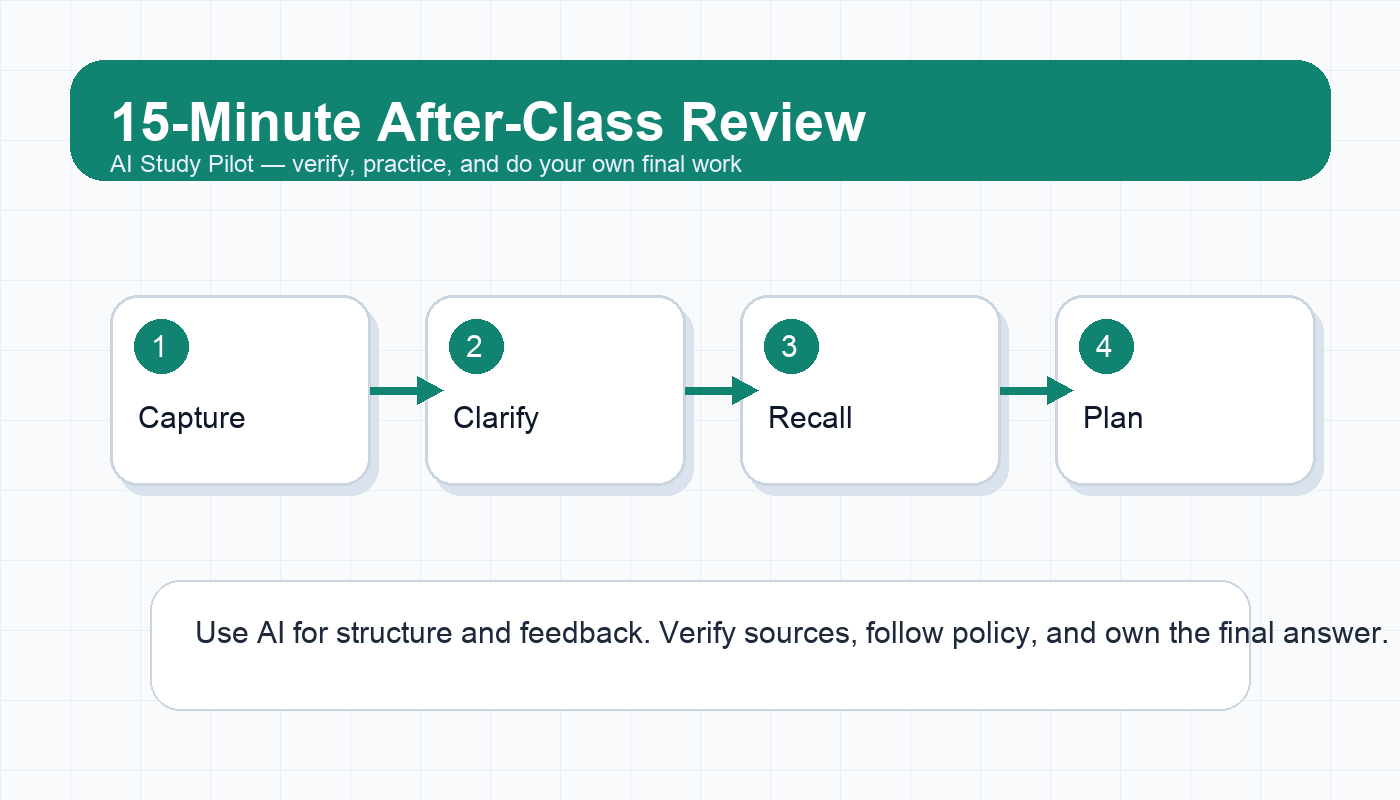
Make the routine boring and repeatable: capture, clarify, recall, plan. Fifteen minutes after class can save hours before an exam because you catch confusion early and convert notes into retrieval practice. AI should be the formatter and question generator; you remain the learner.
Disclosure: AI Study Pilot may add affiliate links later. We recommend free-first tools where possible and never promise guaranteed grades or outcomes.