Flagship guide · Exam prep
AI Exam Prep System: Turn Notes Into Practice Tests, Flashcards, and a 7-Day Review Plan
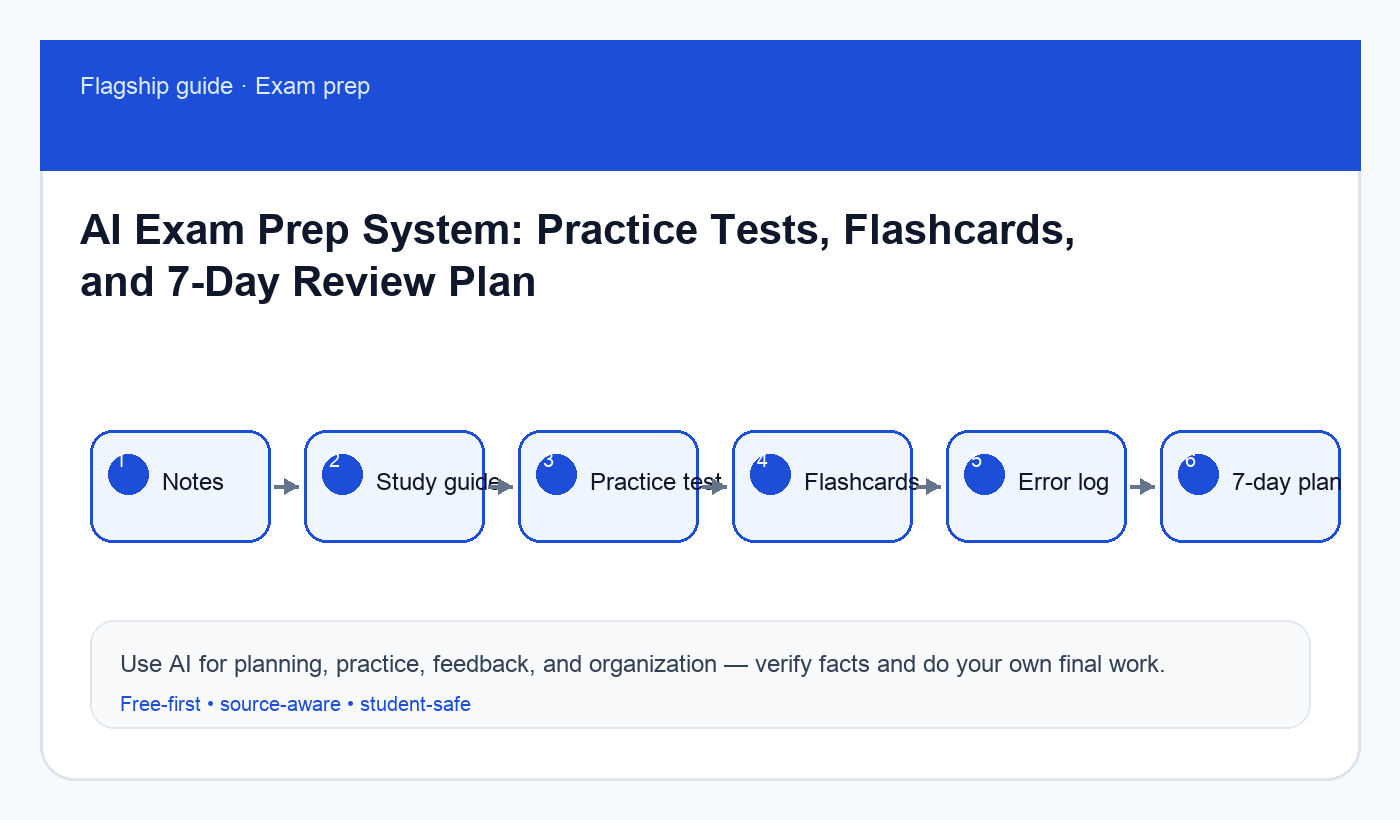
A complete, student-safe AI exam prep system that turns class notes into a study guide, practice questions, flashcards, an error log, and a 7-day review plan.
Quick answer
The safest AI exam prep system starts with your own class materials, not random answers from the internet. Put your lecture notes, slides, textbook chapter headings, returned quizzes, and instructor review sheet into a structured workflow: build a study guide, create practice questions, turn misses into flashcards, keep an error log, and schedule short review sessions over the final week. AI is useful as a coach and organizer. It should not take a live exam for you, answer locked quiz questions, or replace the work your instructor expects you to do.
If you only have one hour, do this: paste your notes, ask for a topic map, generate 15 practice questions, answer them without looking, then ask AI to classify your mistakes into “forgot,” “confused,” or “could not apply.” That one loop beats rereading because it creates retrieval practice. For deeper help, connect this guide with how to make a study guide with AI, AI practice exams from class notes, and AI flashcards from notes.
The safety boundary
Use this system only with material you are allowed to study from. It is fine to ask AI to explain concepts, quiz you, build a review schedule, or critique your reasoning after you attempt a question. It is not fine to paste questions from a locked exam, ask for answers during a graded assessment, or submit AI-written explanations as your own. When the rules are unclear, stay in practice mode and do the final work yourself.
A good rule is: AI can make the workout plan, spot weak muscles, and suggest drills. You still have to do the reps. If a professor asks how you studied, you should be able to say, “I used AI to generate practice from my notes and then checked the answers against class materials.”
The five-part exam prep system
- Stage: Source pack · What AI helps with: Organize notes, slides, readings, old quizzes · What you must verify: Remove private info and use only allowed materials
- Stage: Study guide · What AI helps with: Group topics and learning objectives · What you must verify: Missing topics, inaccurate definitions, wrong emphasis
- Stage: Practice test · What AI helps with: Generate varied questions · What you must verify: Answers and explanations against class sources
- Stage: Flashcards · What AI helps with: Convert misses into recall prompts · What you must verify: Cards are short, accurate, and not too easy
- Stage: Review plan · What AI helps with: Schedule daily retrieval · What you must verify: Time blocks match your real calendar
Step 1: build a source pack
Gather everything that reflects what your instructor actually taught: notes, slides, textbook chapter titles, lab objectives, homework feedback, and review sheets. Do not paste private student information, patient data, employer data, or anything your class rules say cannot be uploaded. If privacy is a concern, summarize the material in your own words first and use the AI privacy checklist.
Label your material clearly. AI works better when it knows what is a lecture note, what is a textbook section, and what is a quiz you already received back. If your notes are messy, start with the AI note-taking system before generating questions.
Step 2: create the study guide before the practice test
Students often skip straight to questions. That can work, but a study guide first gives you a map. Ask AI to group the course material into units, concepts, formulas, definitions, cases, people, dates, or problem types. Then check the map against your syllabus and review sheet. Add anything the model missed.
The output should not be a polished essay. It should be a working document: topic, what to know, common confusion, example, and where to verify it. If the model adds claims that are not in your material, mark them as “CHECK” or delete them.
Copy-ready prompt: exam prep system builder
Act as a student-safe exam prep coach. Use only the material I provide. Do not invent facts, formulas, cases, citations, or exam predictions.

Course and exam format:
[paste what you know]

Allowed study materials:
[paste notes, review sheet, headings, or summaries]

Create:
1. A topic map grouped by unit.
2. A study guide with key ideas, examples, and “verify this” flags.
3. 20 practice questions mixed across recall, explanation, and application.
4. An answer key that cites the section of my notes supporting each answer.
5. A flashcard list for the highest-yield facts and mistakes.
6. A 7-day review schedule using active recall.

Keep the final work for practice only. If evidence is missing, write CHECK IN NOTES instead of guessing.
Step 3: answer first, then get feedback
The most important rule: do not read the answer key before you answer. Print the practice test or copy it into a separate document. Try it closed-book. Then use AI to grade your reasoning against the provided answer key and class notes. Ask for feedback in three buckets: what you knew, what you partially knew, and what you missed.
This is where AI becomes useful. A missed question is not just wrong; it is data. Was the issue memory, vocabulary, setup, formula choice, interpretation, or time pressure? Your next study session should target the reason, not just the topic.
Step 4: turn misses into flashcards and mini-drills
Flashcards work best when they are specific. “Photosynthesis” is too broad. “What happens to water in the light reactions?” is better. For problem-based classes, create mini-drill cards: “When a question asks for percent change, what setup comes first?” Pair each card with the source section where you verified the answer.
Use Anki and AI active recall if you want spaced repetition. Keep cards short, delete duplicates, and avoid cards that only ask you to recognize a sentence. You want recall, not familiarity.
Step 5: run a seven-day review plan
A safe final-week plan uses repeated retrieval. Day 1 maps the course. Day 2 does a first practice set. Day 3 repairs weak topics. Day 4 does mixed flashcards. Day 5 writes explanations from memory. Day 6 takes a second practice test. Day 7 reviews the error log lightly and sleeps.
If you have fewer than seven days, compress the loop rather than dropping practice. Even a two-day version should include one closed-book practice set, one repair session, and one final mixed recall session.
Common mistakes
- Asking AI for “likely exam questions” and trusting guesses instead of your review sheet.
- Reading AI explanations without first trying the problem yourself.
- Making flashcards from unverified AI facts.
- Studying only the topics that feel comfortable.
- Forgetting to check whether the assignment or exam rules limit AI use.
Final recommendation
Build your exam prep around evidence: your notes, your misses, and your instructor’s emphasis. Use AI to organize, question, explain, and schedule. Verify facts against class materials, keep the final assessment honest, and use active recall every day.
Disclosure: AI Study Pilot may add affiliate links later. We recommend free-first tools where possible and never promise guaranteed grades or outcomes.