Support article · Safe submission
AI Rubric Checker for Students: Review Your Assignment Before Submitting
A safe pre-submit rubric-checking workflow that helps students compare drafts to assignment criteria, find gaps, and revise in their own words.
Quick answer
You can use AI as a rubric checker by giving it the assignment instructions, rubric, and your draft, then asking for a gap list—not a rewrite. The safest output is a checklist of missing requirements, weak evidence, unclear organization, citation issues, and questions to answer yourself. Do not ask AI to write the final submission for you, and do not use it on assessments where outside help is banned.
This workflow fits essays, lab reports, presentations, discussion posts, and projects. It pairs with the AI study safety checklist before submitting, Claude writing feedback guide, and citation audit checklist. Think of it as a second set of eyes, not a ghostwriter.
Why rubrics are perfect for safe AI feedback
A rubric tells you what the instructor values: thesis, evidence, methods, organization, citation, formatting, originality, reflection, or presentation quality. Students often lose points not because they know nothing, but because they miss a requirement. AI can compare your draft to the rubric quickly and point out gaps.
The danger is over-revision. If you ask for “make this an A paper,” the model may replace your voice, add unsupported claims, or produce writing you cannot defend. Ask for diagnosis, not substitution.
The rubric-checking workflow
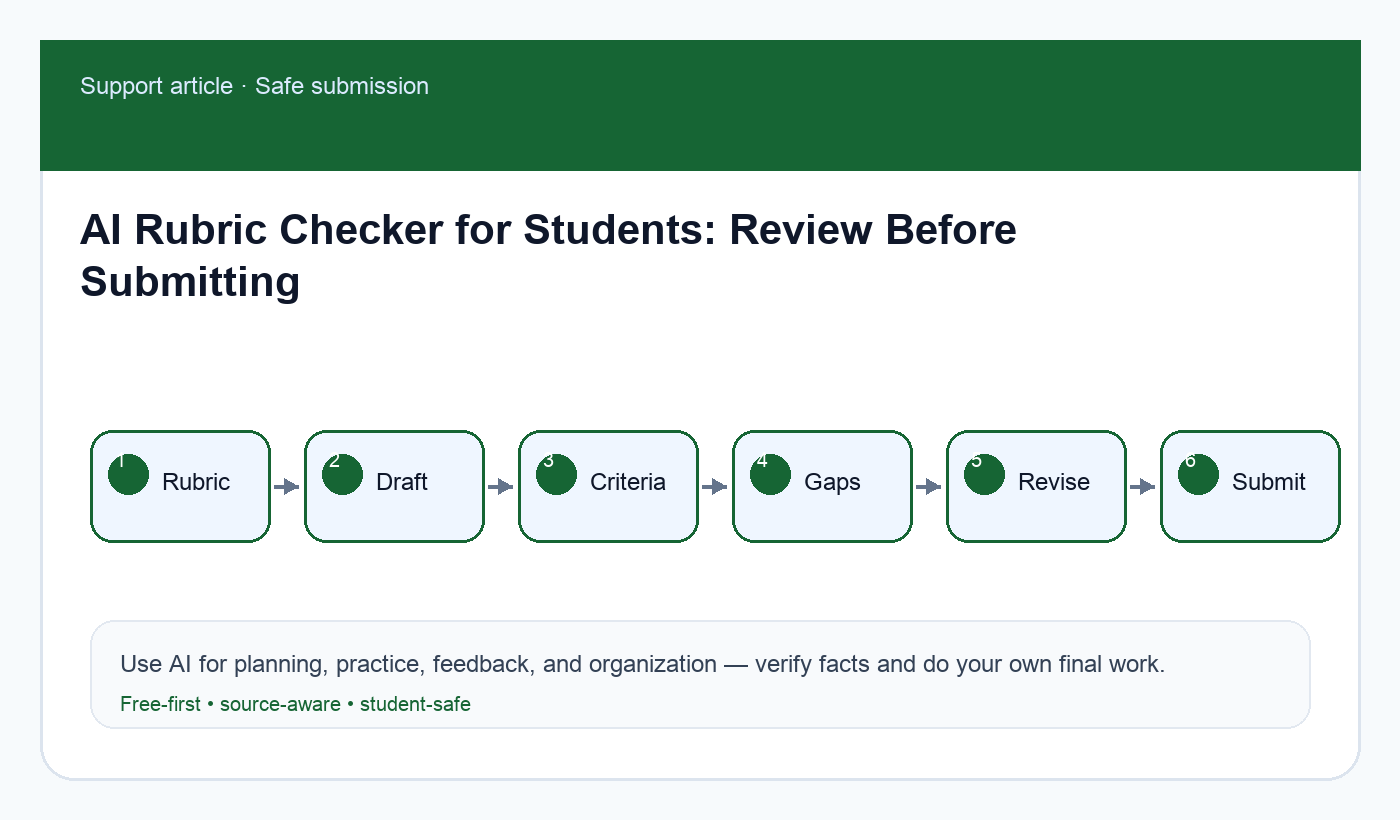
- Input: Assignment prompt · AI task: Identify required deliverables · Student task: Confirm against LMS and syllabus
- Input: Rubric · AI task: Turn criteria into checklist · Student task: Decide what matters most
- Input: Draft · AI task: Find gaps and unclear sections · Student task: Revise in your own words
- Input: Sources · AI task: Flag weak support or missing citations · Student task: Verify and cite real sources
- Input: Final version · AI task: Run pre-submit check · Student task: Submit only work you can explain
Step 1: prepare clean inputs
Paste the assignment prompt and rubric first. Remove private comments, grades, student IDs, peer names, and sensitive data. If the assignment includes confidential material, summarize it instead. Then paste your draft or selected sections. If your school has an AI disclosure rule, include it in the prompt so the feedback respects the policy.
If the rubric is long, ask AI to convert it into a checklist before reviewing the draft. This helps you see the target clearly.
Copy-ready prompt: rubric gap review
Act as a rubric checker and revision coach, not a ghostwriter. I want feedback I can use to revise in my own words.

Assignment instructions:
[paste]

Rubric:
[paste]

Course AI policy, if known:
[paste or write unknown]

My draft:
[paste]

Please provide:
1. A rubric checklist with met / partly met / missing.
2. The three highest-priority fixes.
3. Places where evidence, citation, or explanation is weak.
4. Questions I should answer myself before submitting.
5. A final integrity check for policy, privacy, sources, and my own voice.

Do not rewrite the assignment. Do not add new facts or citations. If evidence is missing, tell me what to verify.
Step 2: read feedback like a checklist
AI feedback is not a grade. It is a draft review. Treat each suggestion as a possible issue, not a command. If the model says your thesis is unclear, check whether the rubric asks for an argument. If it says you need more evidence, check your sources. If it suggests a new claim, verify it before using anything.
Make a revision plan with three priorities. Too many comments can freeze you. Fix the highest-value items first: missing requirement, unsupported claim, weak organization, citation gap, or unclear conclusion.
Step 3: protect your voice
Rubric checking should make your work clearer, not generic. If AI suggests polished wording, use it only as a signal for what is unclear. Rewrite the sentence yourself. You should be able to explain every paragraph, source, and decision.
For writing-heavy assignments, compare your revised draft to your earlier work. If it suddenly sounds like a different person, slow down. The balance AI feedback with your own writing voice guide can help.
Step 4: run a citation and fact check
Rubrics often include evidence. AI may notice missing citations, but it cannot guarantee that a source supports your claim unless you provide the source text and verify it. Before submitting, open your sources. Check quotes, page numbers, data, dates, and paraphrases. If a citation was created or formatted with AI, audit it carefully.
Use how to verify AI answers before studying for factual claims and the AI citation tools guide for bibliography checks.
Common mistakes
- Asking AI to rewrite the whole assignment instead of checking the rubric.
- Ignoring course rules about AI feedback.
- Accepting new claims or citations without verification.
- Trying to fix every small style comment before missing requirements.
- Submitting wording you cannot explain as your own.
A simple revision priority system
After the AI returns feedback, sort every issue into three levels. Level 1 is a requirement problem: missing section, wrong format, no thesis, no method, missing citation style, or ignored prompt question. Fix these first because they can cost major points. Level 2 is an evidence problem: claim needs support, quote needs context, example is too vague, or data is not explained. Level 3 is polish: awkward wording, transitions, formatting, and small style issues.
This order matters. Students often spend an hour polishing sentences while the rubric still says the paper needs a counterargument or source analysis. A rubric checker is most useful when it helps you choose the next repair, not when it overwhelms you with every possible improvement.
What to disclose if your course requires AI transparency
Some instructors ask students to disclose any AI assistance. Follow the exact wording your course requires. A transparent note might say that you used an AI tool to compare your draft against the rubric and identify revision priorities, but that you wrote the final submission yourself and verified sources manually. Do not hide tool use if the policy requires disclosure.
If the policy is unclear, keep a private process log: date, tool, what you asked, and what you changed. That log protects you if you need to explain your process later and encourages you to use AI as feedback rather than replacement.
Final recommendation
Use AI rubric checking near the end of your draft, when you have something real to review. Ask for gaps, priorities, and questions. Then revise yourself, verify sources, keep your voice, and submit only work you can defend honestly.
Disclosure: AI Study Pilot may add affiliate links later. We recommend free-first tools where possible and never promise guaranteed grades or outcomes.