Subject workflow · Philosophy reading
How to Use AI to Study Philosophy Readings Without Skipping the Text
A non-STEM subject workflow for turning difficult philosophy readings into argument maps, questions, and discussion prep.
Quick answer
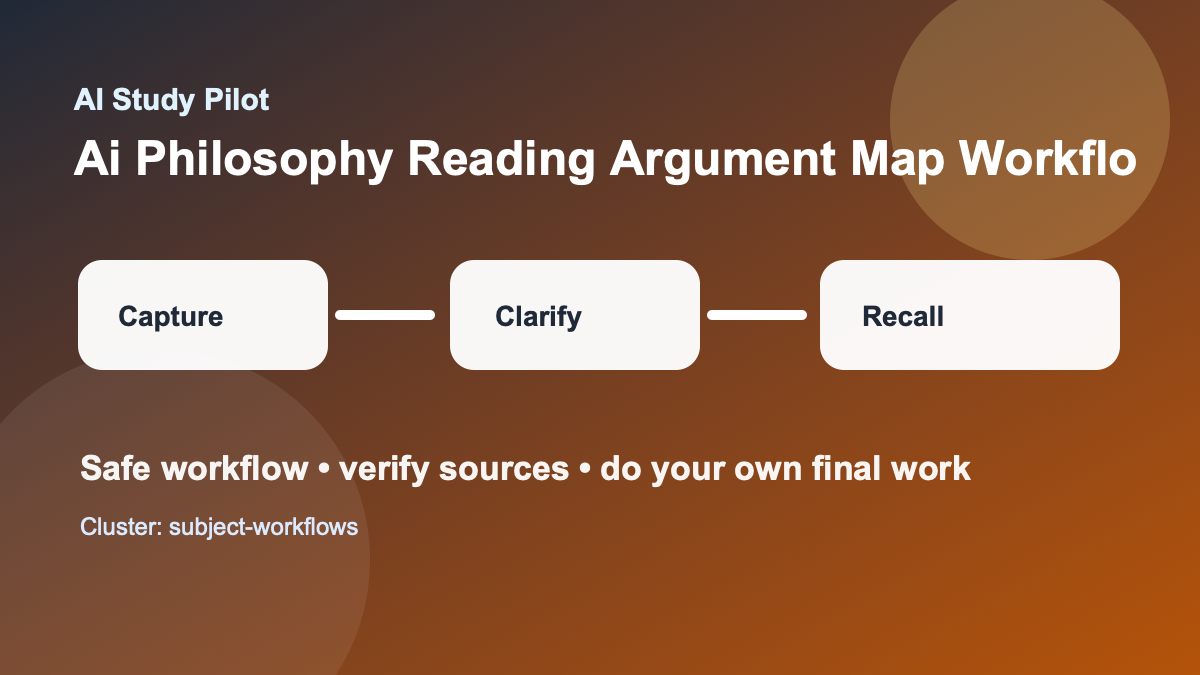
You can use AI to study philosophy readings safely if you make it map the argument rather than replace the reading. Read the assigned text first, mark confusing passages, then ask AI to identify the thesis, key terms, reasons, objections, and examples using only the excerpts you provide. The final goal is your own argument map and discussion questions, not a generic summary copied from the internet.
This workflow is similar to the history primary-source analysis workflow and the literature close-reading workflow: AI helps you slow down, name the parts, and prepare better questions. It should not become a shortcut around the text.
Academic integrity guardrails
Use this workflow to understand, plan, practice, and check your own work. Do not use it to generate answers for locked quizzes, bypass course policies, submit uncited AI writing as your own, or replace assigned reading entirely. If your instructor gives stricter rules, follow those first. When you paste material into any tool, remove private information and use the AI privacy checklist first.
The safest pattern is simple: bring your own course material, ask for organization or practice, verify the output against the source, then write or solve the final version yourself. If the model sounds confident but you cannot trace the answer back to your notes, textbook, or a credible source, treat it as a lead to check rather than a fact to trust.
Why philosophy readings feel difficult
Philosophy texts often use ordinary words in technical ways. A paragraph may define a term, defend a claim, answer an objection, and rely on an assumption all at once. If you ask AI for “a summary of Plato” or “what Kant means,” you may get a broad overview that sounds helpful but does not match your assigned passage.
The safer move is passage-based. Work with a paragraph, page, or section at a time. Ask the model to separate what the author says from what the model thinks it means. Then check the interpretation against the text.
Copy-ready prompt: argument map from a passage
You are my philosophy reading assistant. Help me understand the argument in this assigned passage. Do not replace the reading or add unsupported claims.

Rules:
- Use only the passage I provide unless you label outside context as BACKGROUND.
- Quote short phrases from the passage when identifying claims.
- If the argument is ambiguous, list two possible interpretations.
- Do not write my essay or discussion post for me.

Course/topic:
[paste course and topic]

Passage:
[paste excerpt]

Output:
1. Main question the passage is trying to answer.
2. Thesis or central claim.
3. Key terms and how the passage uses them.
4. Reasons/evidence supporting the claim.
5. Objections or tensions in the passage.
6. A simple argument map in bullets.
7. Three discussion questions I can bring to class.
Build the argument map
A useful philosophy argument map has five labels:
Question: the problem the author is addressing.Claim: what the author wants the reader to accept.Reason: why the author thinks the claim is true.Objection: a possible challenge or rival view.Reply: how the author answers the objection.
After AI drafts the map, go back to the text and underline the exact sentences that support each label. If you cannot find a sentence for a label, mark it CHECK. This turns the map into a reading tool instead of a polished hallucination.
Use AI for definitions carefully
Definitions are dangerous because philosophy courses often care about the author’s exact use of a term. Ask AI for two columns: “ordinary meaning” and “meaning in this passage.” Then verify the passage-specific column yourself.
Example question: “Does the author use freedom as absence of constraint, rational self-rule, political right, or something else?” The point is not to memorize a dictionary definition. The point is to see how the argument depends on a term.
Prepare for class discussion
Discussion prep should make you more present in class, not less. After mapping the reading, generate three types of questions:
- Clarifying question: “When the author says X, do they mean A or B?”
- Evidence question: “Which part of the passage best supports the claim?”
- Challenge question: “Would the argument still work if we rejected assumption Y?”
Bring the questions in your own words. If you use AI wording that sounds unlike you, rewrite it. Your instructor is not grading how polished the question sounds; they are looking for real engagement with the reading.
From reading map to paper outline
If the reading later becomes part of a paper, do not ask AI to write the paper. Ask it to help compare possible thesis directions, then use the AI essay feedback workflow after you draft your own argument. You can also use the AI outline for humanities papers to plan structure without outsourcing the writing.
A safe bridge prompt is:
Based on my argument map below, help me brainstorm possible paper questions. Do not write a thesis for me. Give me 5 directions, what evidence each would require, and what would make each direction too broad.

My argument map:
[paste map]
Common mistakes
The first mistake is asking for summaries before reading. That trains you to recognize AI’s wording instead of the author’s argument. The second mistake is treating outside background as if it were in the assigned passage. The third mistake is skipping objections, even though objections are often where the philosophical work happens.
A better habit is to let AI make the text more inspectable. If the output sends you back to the passage with sharper eyes, it is helping. If it lets you avoid the passage, it is hurting your learning.
Where to go next
If this guide helped, pair it with the AI study system for college students, the AI hallucination checklist, and the AI study safety checklist. For exam-heavy weeks, move from planning into the 7-day AI exam plan, the AI flashcards workflow, or the practice exam from notes guide.
FAQ
Can AI do this whole process for me?
No. The point is to make your learning process clearer, not to outsource it. AI can structure messy information, ask questions, and suggest next steps, but you still need to read, practice, verify, and create the final work.
What if the AI output looks wrong?
Assume it might be wrong. Ask the tool to quote the exact source line it used, compare it with your original notes or reading, and mark anything uncertain as CHECK. Use the citation audit checklist when sources are involved.
Should I tell my instructor I used AI?
Follow your course policy. When disclosure is required or helpful, keep it plain: say which tool you used, what you used it for, and which parts of the work are your own. Do not hide AI use when the policy asks for disclosure.
Disclosure: AI Study Pilot may add affiliate links later. We recommend free-first tools where possible and never promise guaranteed grades or outcomes.